Gelis: Final Cut

GelIS- Final Prototype

GelIS- Final Prototype

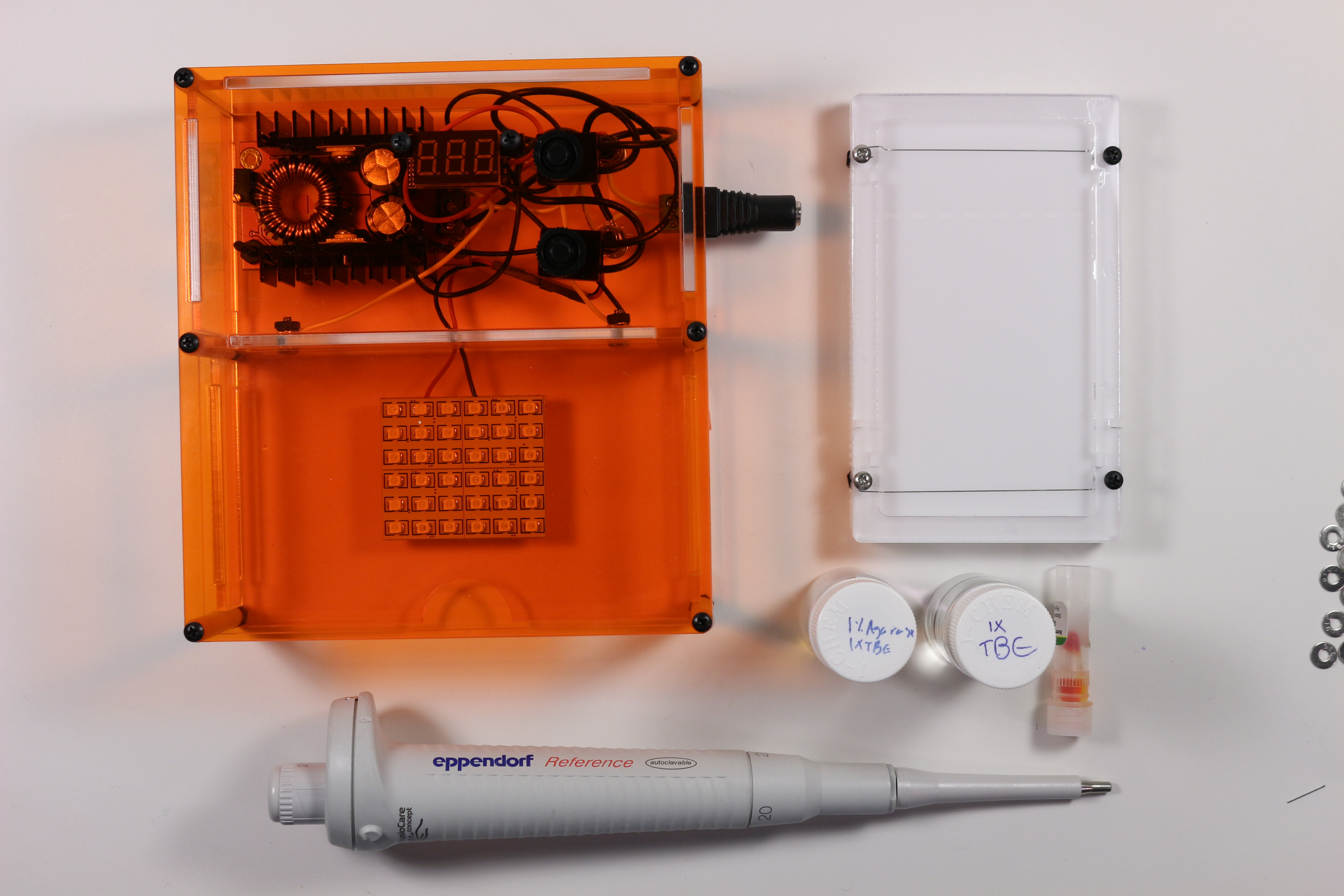
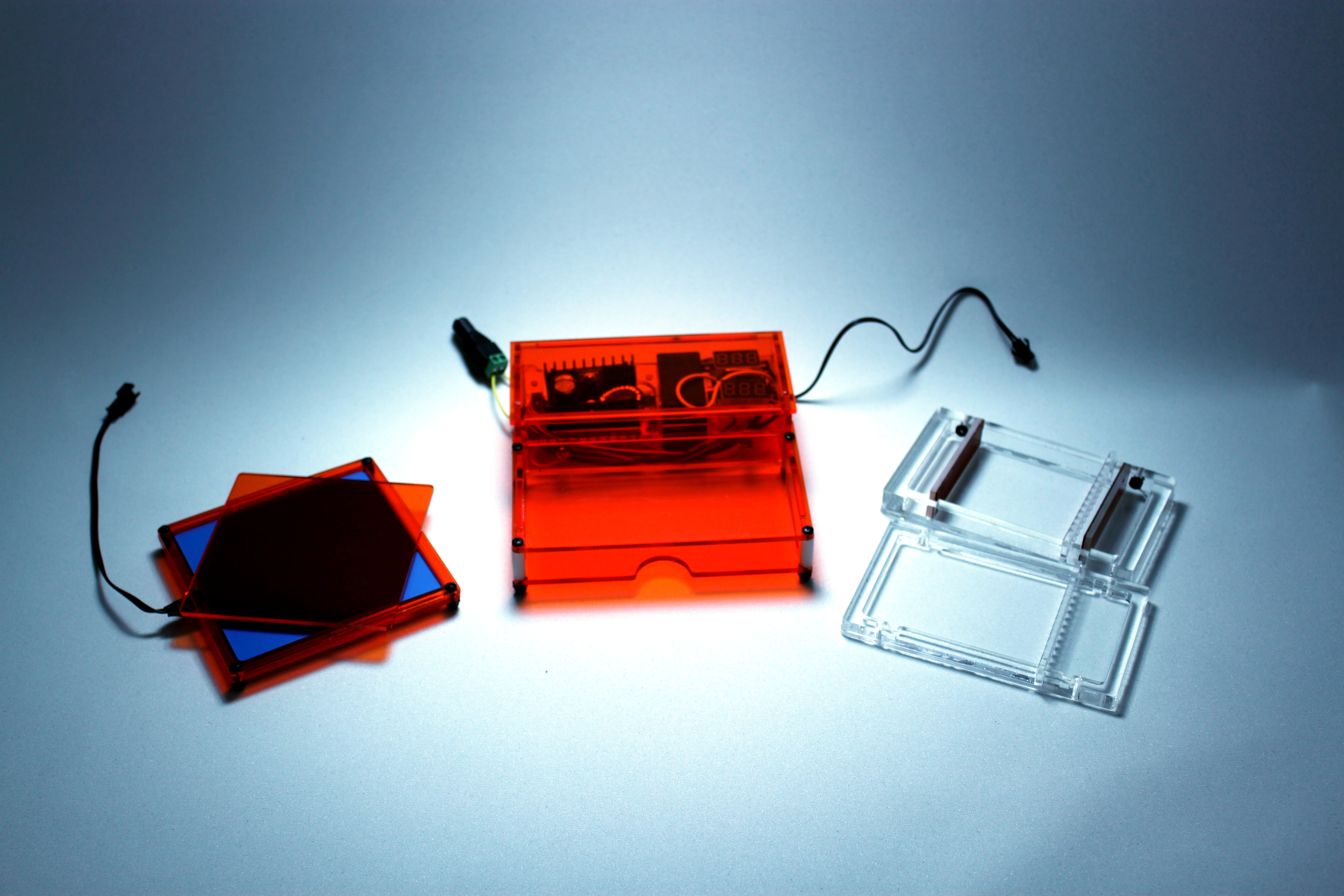
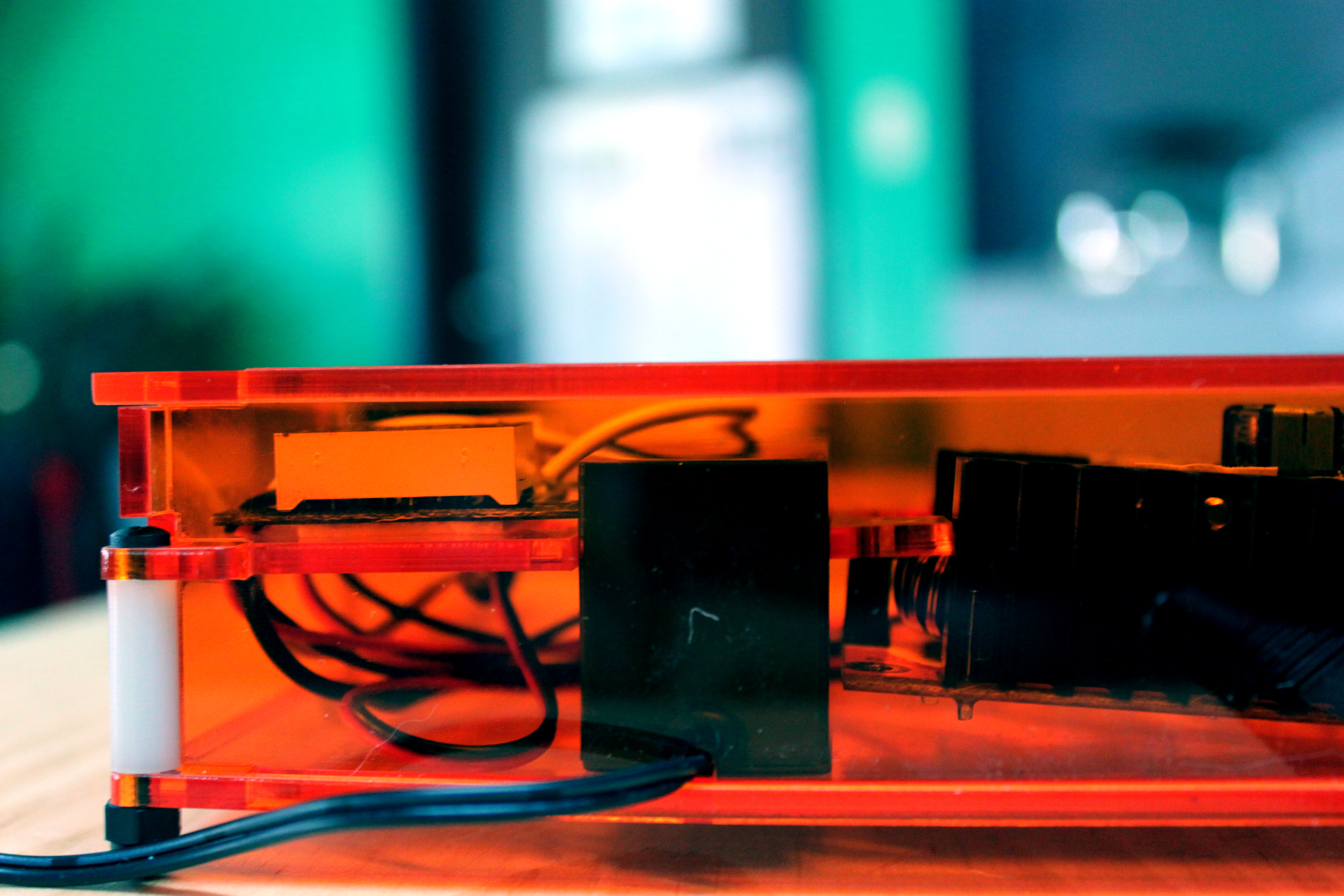
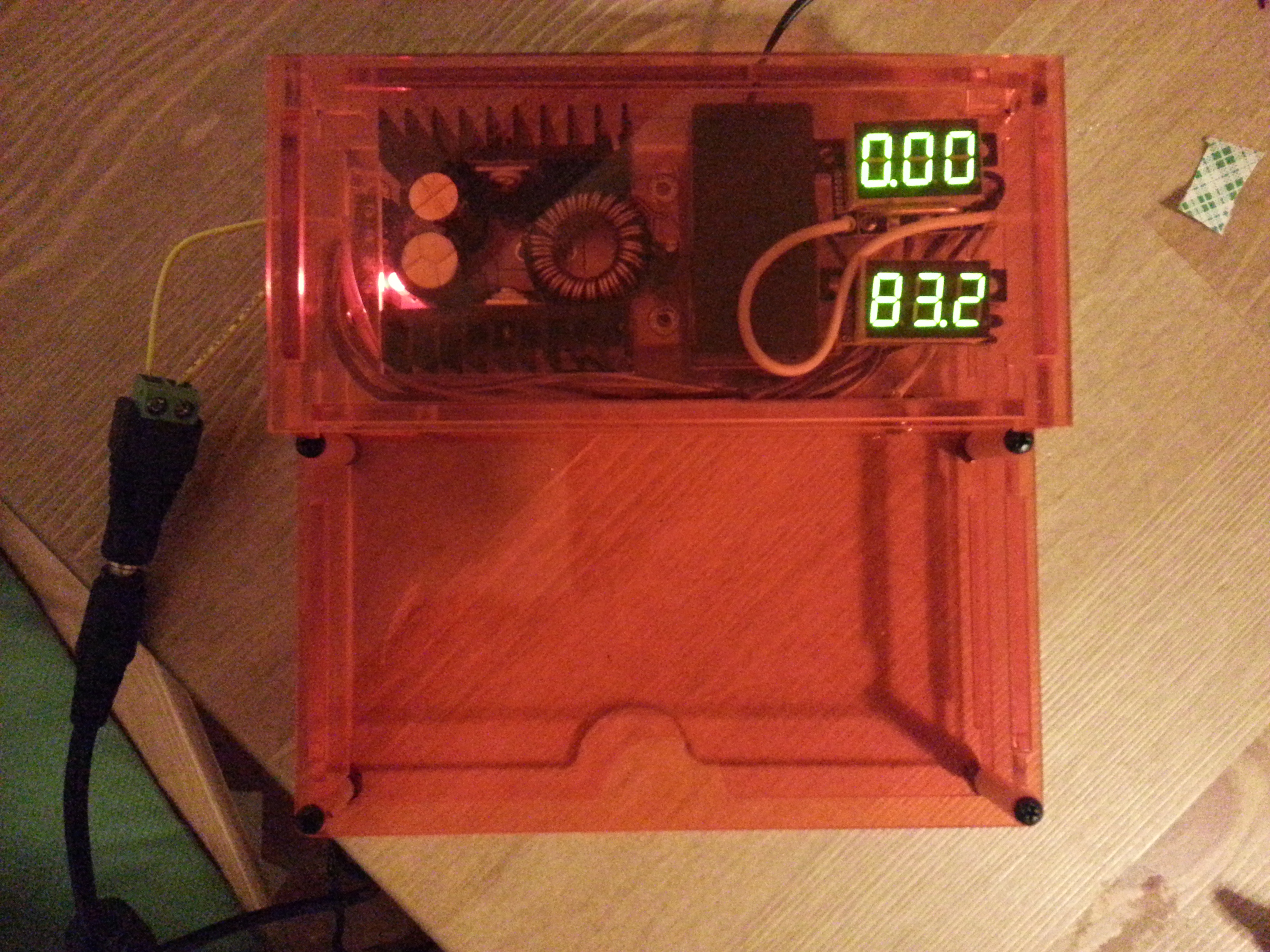
The Gel Integrated System is done.  I have packed an electrophoresis power supply, illumination, and casting system into one tiny box.  All the parts, other than the enclosure, are off the shelf parts.  It can be shipped flat and assembled with only a screwdriver.  This all comes in at a sale price that is an order of magnitude lower than commercial systems, with a bench footprint an order of magnitude lower than commercial systems.

Test Run

Test Run

It has been tested, and it is completely functional.  The gel is bright enough that you can take pictures of it with your cell phone.  If you want to get one, I will be selling the first batch of ten here for $200 a piece.  Use that link to contact me if you need a large batch, or find me on the diybio mailing list.  I will hopefully have an assembly video (and feature video) soon, but until now you can see my instructable on assembly here.

GelIS Simplified

The latest GelIS prototype

The latest GelIS prototype

Almost ready to test the latest prototype!  Everything electrical is go, but I managed to loose my LED panel in my moves from showing my prototype in CA, visiting the bay area, and them moving from an apartment in Somerville back to school.  Oops.

IMG_1401

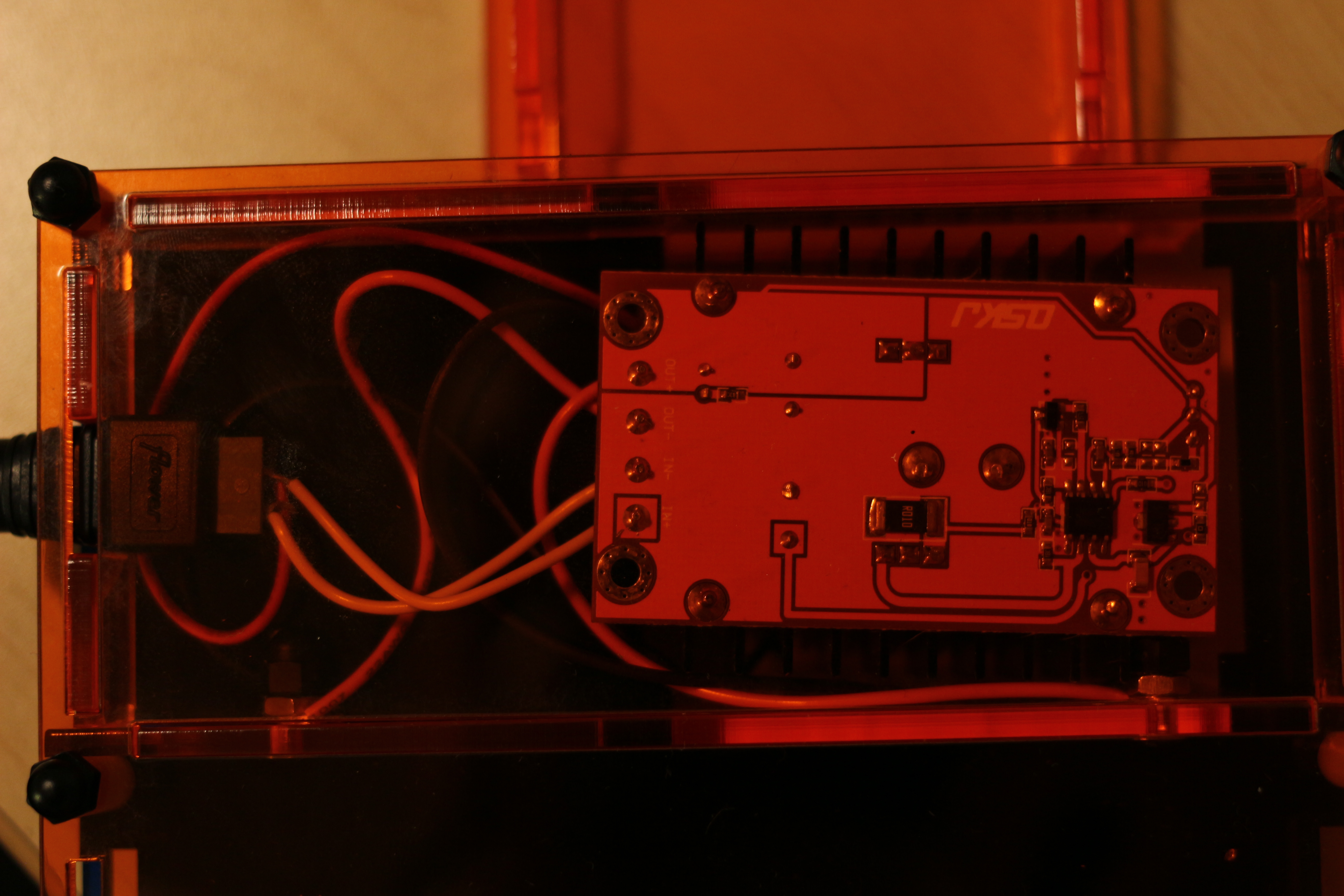
One of the major improvements in this prototype is simplified wiring.  I did away with the ammeter (since it was on the fritz anyways), and now it is very easy to assemble with only a screwdriver.  The improvement is that lots of wires don’t need to go into screw terminals now- there is a max of only two wires per terminal, and if you wrap stranded wires around solid wires, you have a pretty solid connection.

I am really looking forward into getting these into peoples hands!

GelIS: Light at the end of the Tunnel

GelIS Tray Holds Water

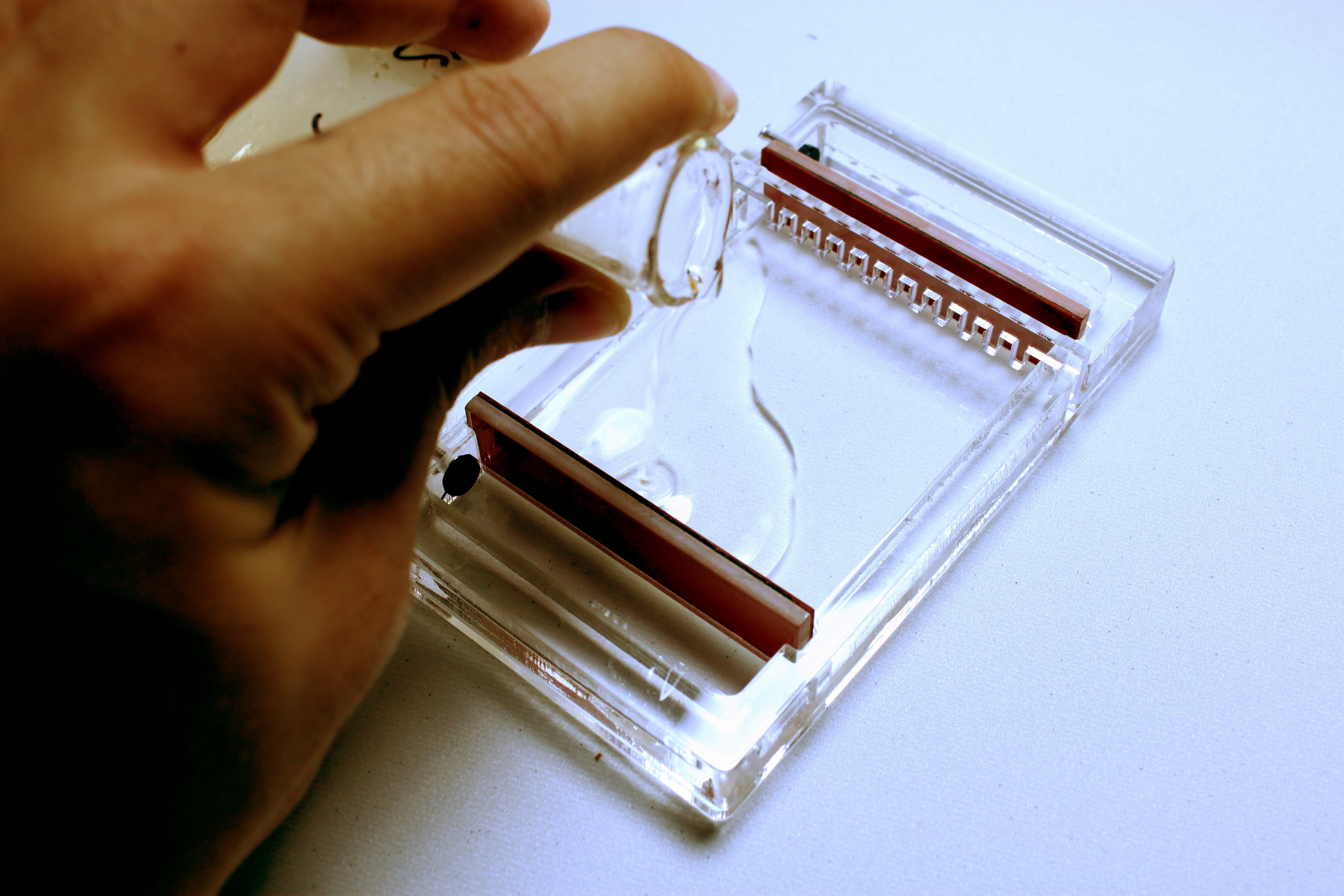
GelIS Tray Holds Water.  You can see the water on the rubber dam, and it is totally contained!  Hooray!

This is the newly designed tray for the gel system.  It is a major improvement over the last tray, and it comes with some other major revisions to the box.  The big upgrades to the tray are:

  • about 2x cheaper
  • built-in diffuser
  • tighter slots for the dams (orange things in that picture) by .005″

This makes the tray system pretty solid, and the low profile saves gel and buffer, and makes it even harder to get your digits into anything that is electrified.  It also makes the box 100% cuttable, with no need to drill any holes, which was an issue since the laser cutters I use can’t focus on an object that is 3″ high.

The other major revision that is coming is an adjustable LED light source.  I love the EL panel, but it is tough to get a good photo without a decent camera, and it is just not as bright.  Even though the EL panel is great for me, I expect that some people will just want to use a cell phone, which is not feasible with the EL panel as it is. Heck, my phone is my lab notebook, and carrying around a big camera is inconvenient, so most of the time it is all I have (I am advocate of the lab having a camera).

With the dam sorted and the illuminator design tested, I am ready to call the next revision the minimal viable product and ship it out.

GelIS Prototype Two: Wet Test Success!

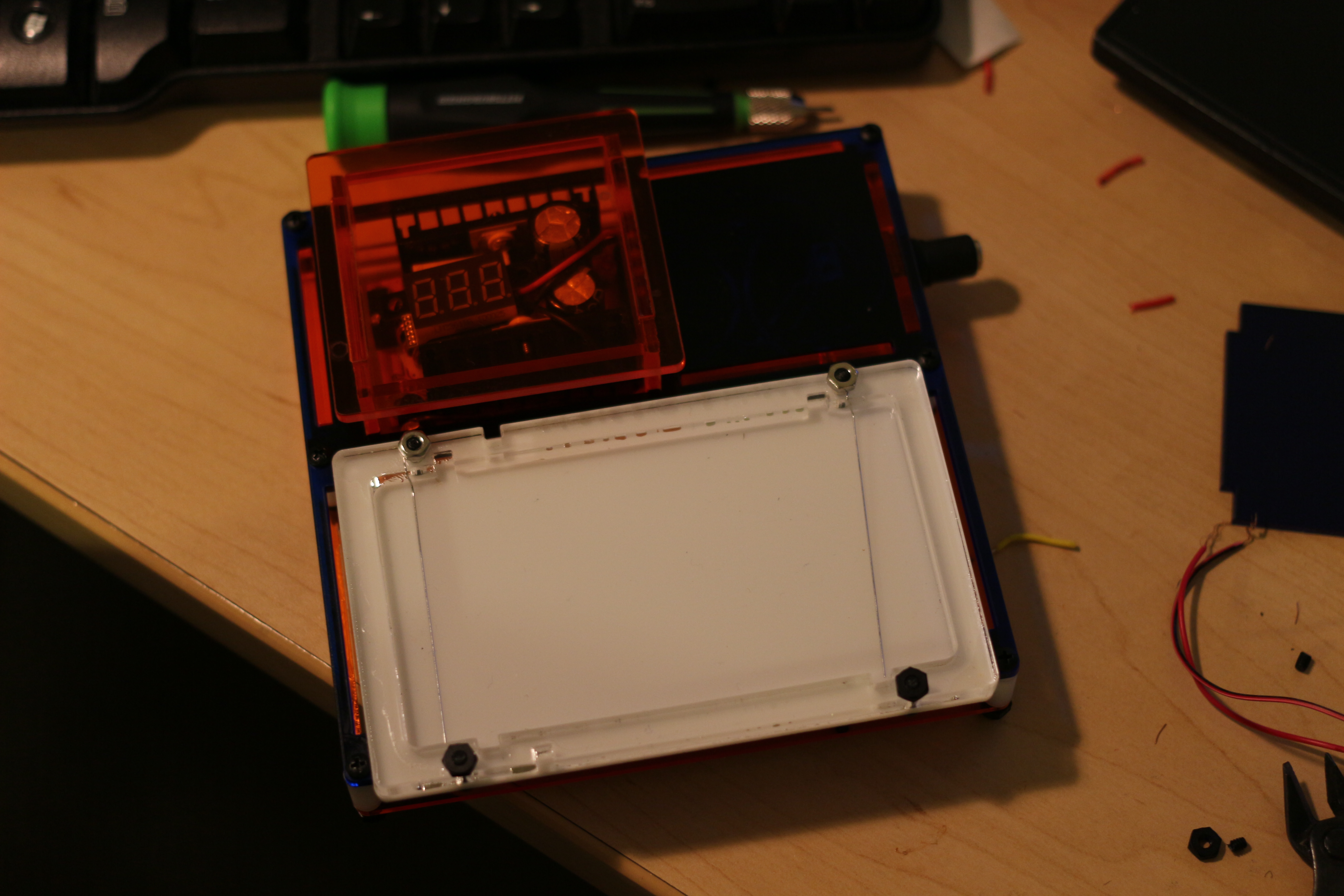
The Gel Integrated System in all its glory

The Gel Integrated System in all its glory

The second prototype of the Gel Integrated System is done.  I ran a gel on it (wet tested it) today, and I am happy to say that I am ready to sell, build, and ship the first few units.  There are a few minor revisions that will go out in the first few units, like a clear “lid”, and slightly different dimensions for the wire cutouts, but mostly they will be the same as what I tested today.

Here is a brief rundown of how the test went.

Pouring the gel, 1% Agarose in 1X TBE with gelgreen 5ul/ml

Pouring the gel, 1% Agarose in 1X TBE with gelgreen 5ul/ml

Pouring the gel started out ok, but I need to get the seals a little wider and the slot that they go into a little thinner, so they seal.  The leakage I experienced should be a non issue for future users.

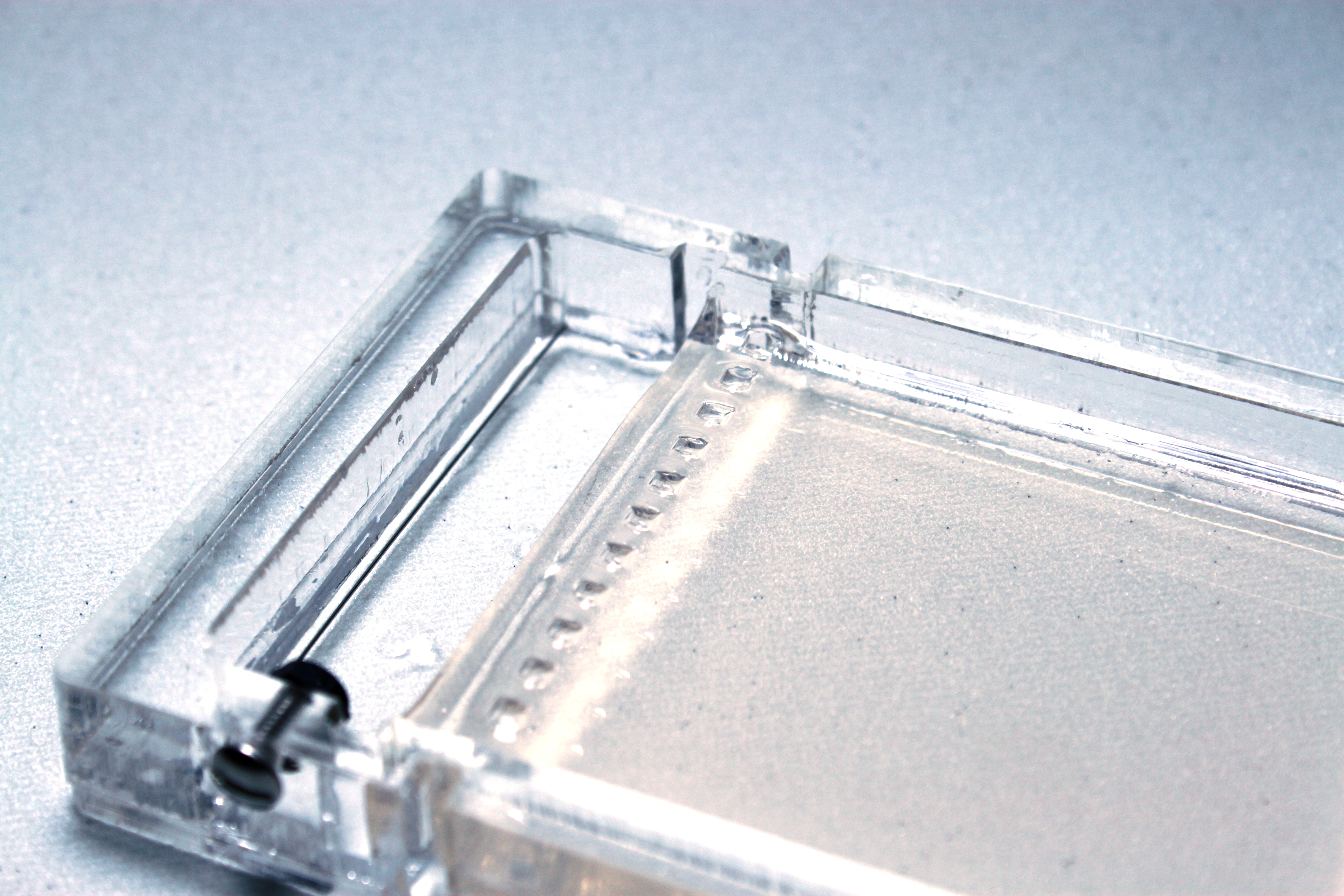
Here is a closeup of the gel and the electrodes.

Here is a closeup of the gel and the electrodes.

It is literally impossible to run this box backwards by accident, since you can only put the tray in in one direction.  If you wanted to run it “backwards” you could pull the electrodes out and move them to the other side, but otherwise your DNA will always be loaded on the right side.  The wells need to be wider and thinner, but setup for this part is slick and simple., and changing the width of the wells is as simple as cutting the comb out of thinner plastic.

IMG_4871

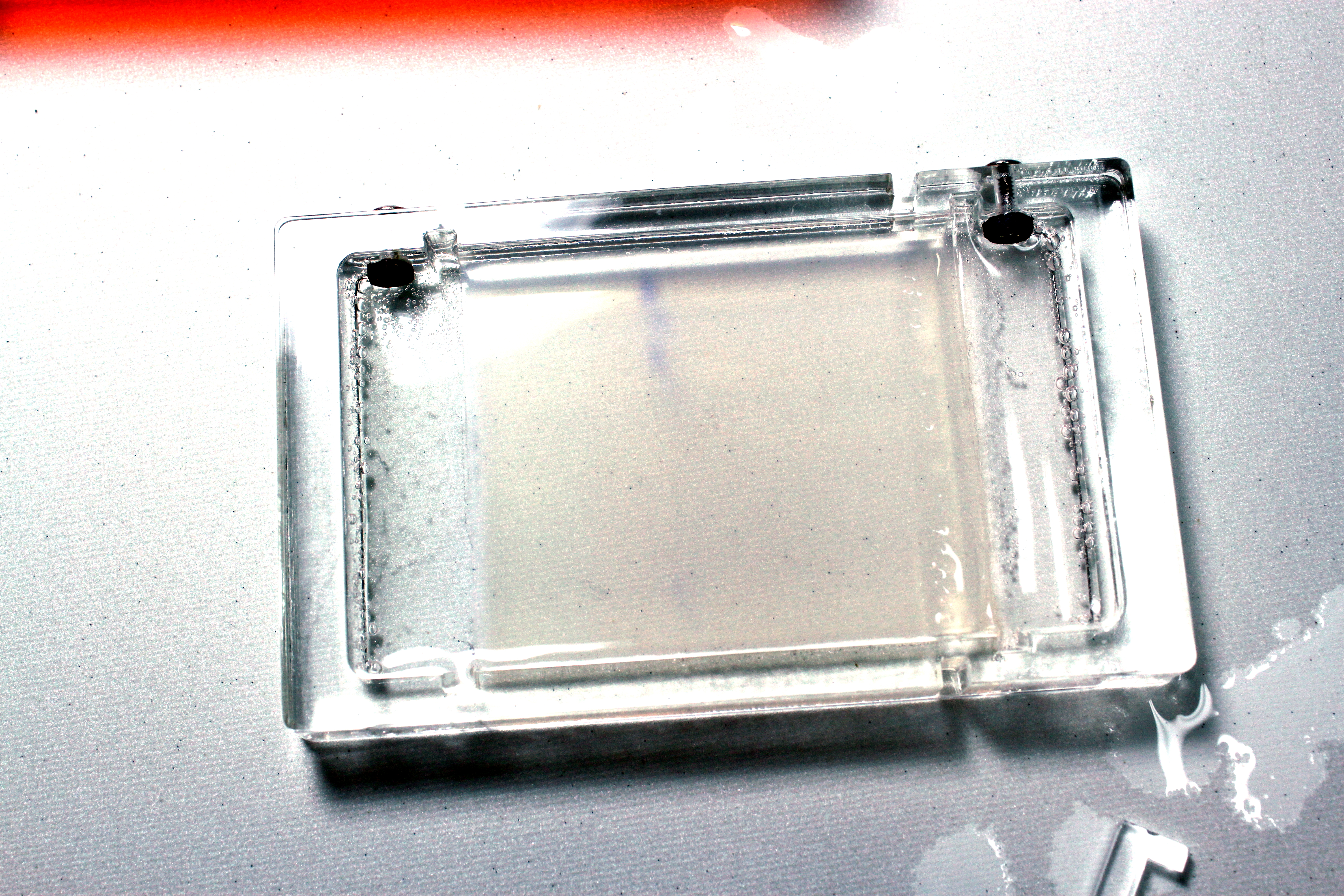
The bands on the top and bottom ran very evenly!

Here is the post-run gel, in regular light  You can barely see the loading dye on the bottom, since I didn’t quite get the sample in the well, but the lanes ran very evenly.

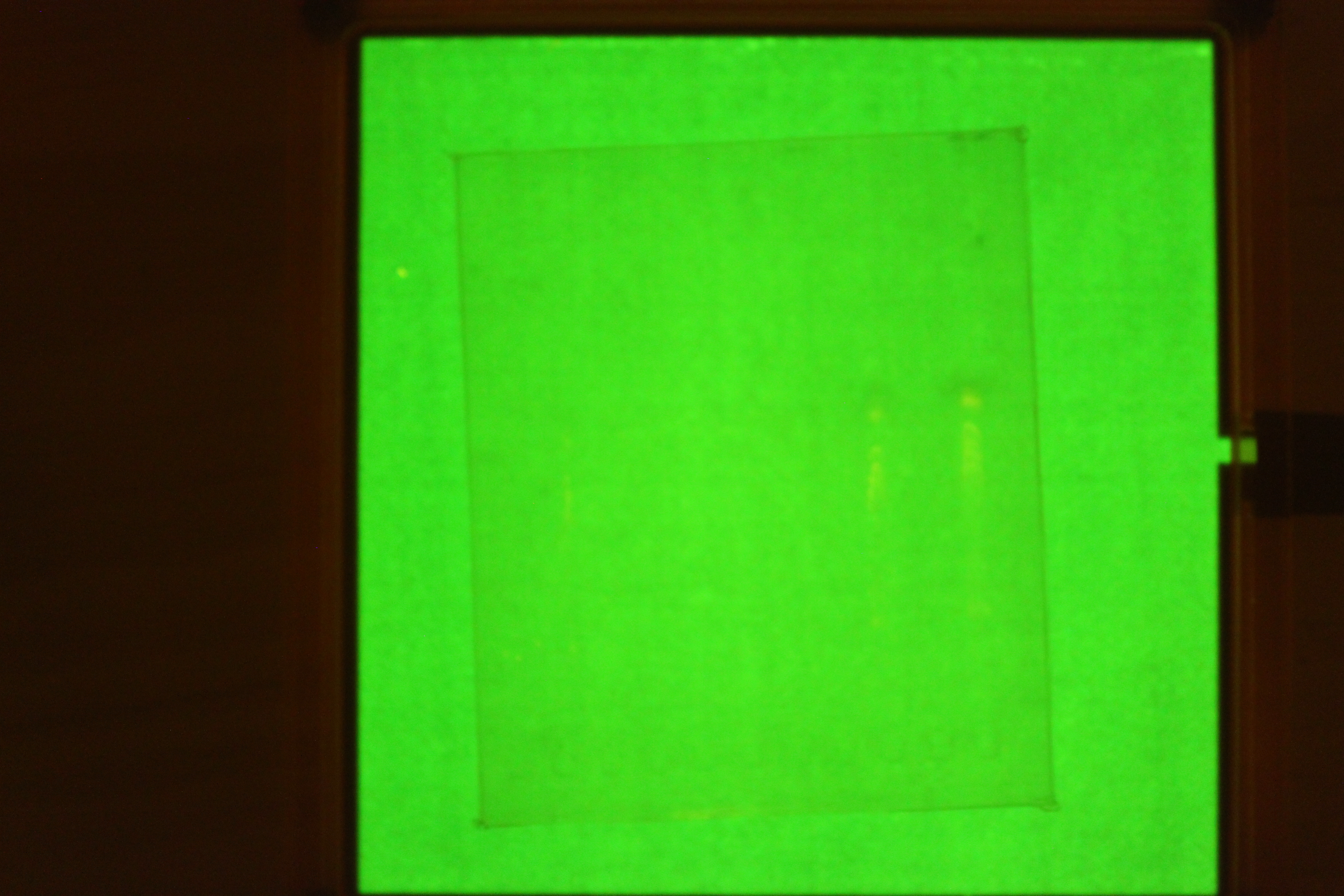
Gel imaging is hard.

Gel imaging is hard.

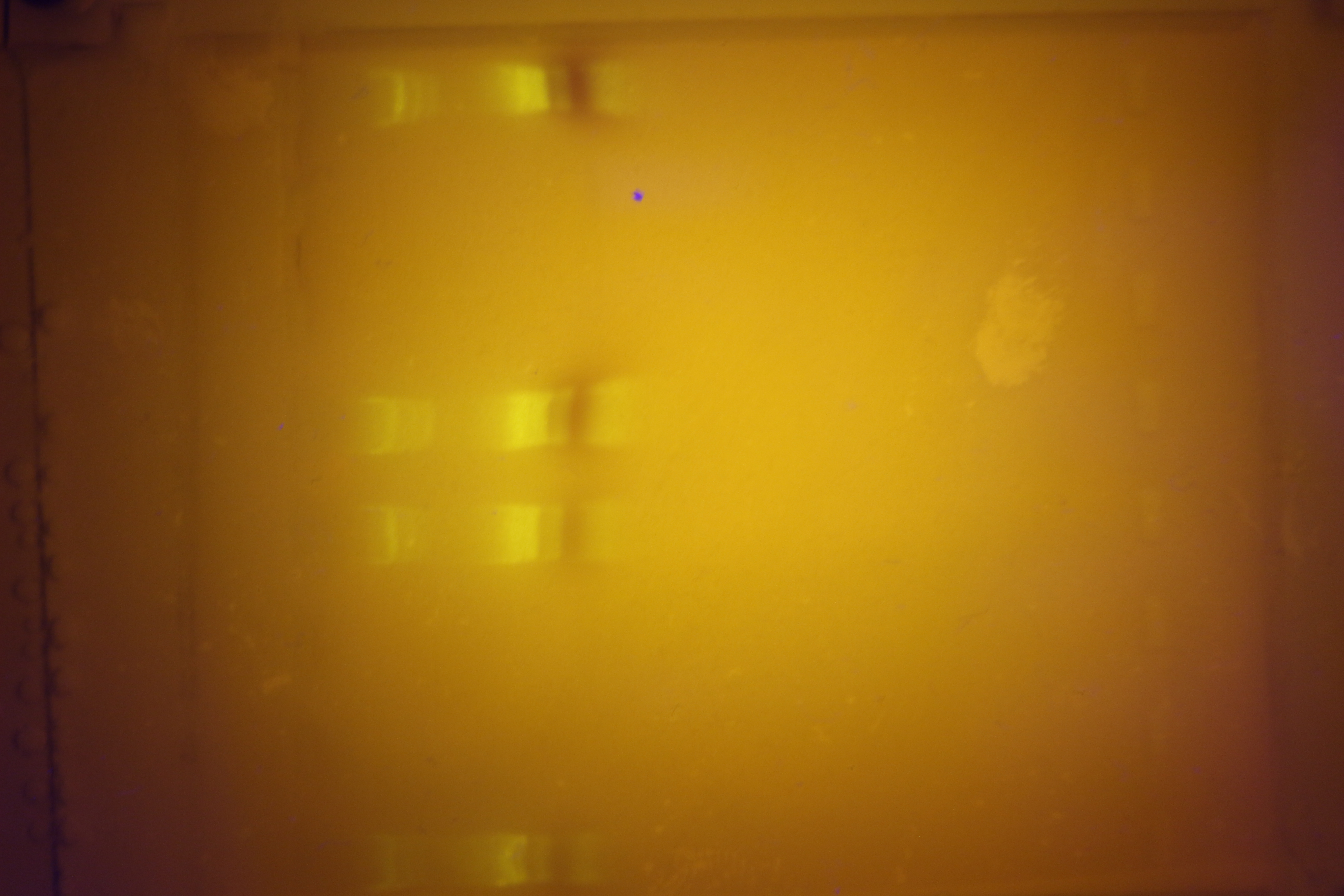
This picture shows two things: one, I might need a pre-filter if I want to do photography.  Two, you can barely see that the the gel did run, but that the sample wells need to be broader so you get the nice crisp bands that everyone loves.  In real life it is quite a bit more visible.  We will see what people want!

Overall, I  would call it a success.  A few tweaks need to be made on the units to be shipped out, but it’s time to try to get this thing out there, and have people use it!

GelIS Prototype Two, Fabrication Notes

The second prototype has seen large improvements in fabrication.  Other than the obvious problems, like the box being too small, there have been a few big improvements.

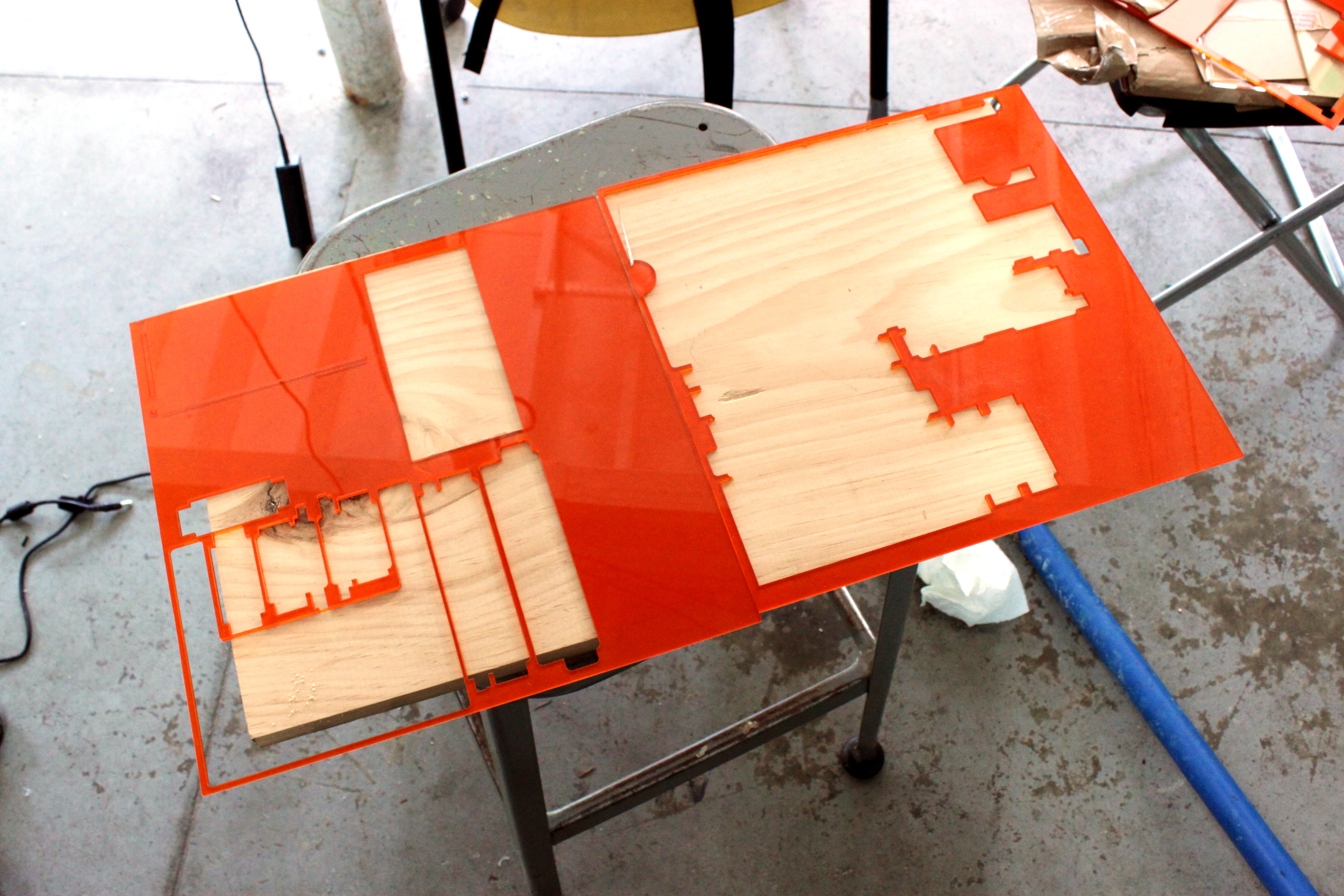
Spot the difference!

Spot the difference!  The left cutsheet should be missing the upper left hand portion, but that part was not cut because it was too large for the sheet.

On the left is the cut sheet from the previous prototype, and on the right is the cut sheet of the latest prototype.  The latest prototype is actually larger by square inches, but it takes almost half the time to cut!  And there is less waste of material between the parts.  The improvement here was manually aligning pieces to share edges, and then deleting (again, manually) one of the shared edges.  If you do this, deleting the extra edge is very important.  If you don’t the laser will hit it again, and sometimes create a very small “peel” of plastic between the two laser lines.  This piece of plastic is very thin, and will be insulated by air on post sides, which will cause it to catch on fire!  So delete the extra line.

IMG_4889

This is the “mouse door” cutout that lets you route cables with big connectors through small slots in mortise joints.  This one is still slightly too small, but it still works pretty well!

left, new box.  Right, old box

left, new box. Right, old box

I also changed the box configuration.  On the left is the new box, which is thinner and more affordable to fabricate.  It eliminates the on-edge holes, which I normally have to drill.  Originally I wanted to turn the tray on-edge and just laser cut the holes, but the cutter was not tall enough for that.

Thats all for this note!

GelIS: Second Cut

Image

One more cut of the gel box.  It is looking really good, and there are only a couple of tight spots where the wires enter/exit the box.  It was assembled with only a screwdriver!  Tomorrow I will do a “wet test” of the system, and see how it fares.

DNA Sequence Allignment From Forward and Reverse Reads

The year is 2013.  Why is it when you Google “How do I align my forward and reverse sequences” the two methods that come up are using ClustalW (Clustal Omega), which requires a reference sequence, or some kind of awful witchcraft involving Microsoft word and the search function?  I guess there are also some programs out there that you have to pay a large sum to use (squencher etc.) but I certainly don’t have that kind of money.

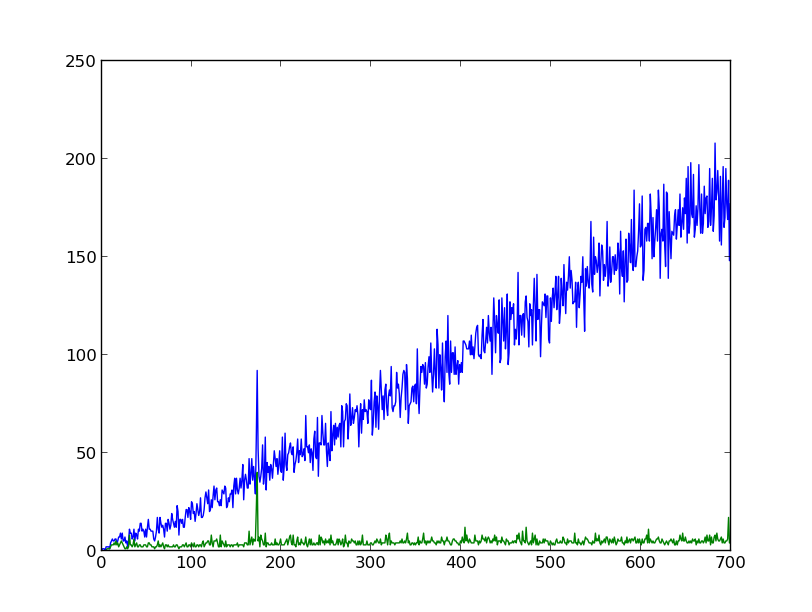
X axis: number of base pairs overlapped from forward and reverse sequence Blue: number of pairs matching Green: "longest run"

X axis: number of base pairs overlapped from forward and reverse sequence
Blue: number of pairs matching
Green: “longest run”

So I decided to write a little python script to help me do alignments.  The output, which you see above, is not very user friendly yet, but it at least gives you a place to start before you devolve to microsoft word (of all things!  I will probably use libreoffice though).

Let me explain whats going on up there.  The script, which is called DNACrusher, takes the forward and reverse reads from your plasmid, and takes the reverse complement of the reverse read.  Then it overlaps the ends that should overlap (the end of the forward read, and the beginning of the reverse complement) by an increasing number of basepairs and counts two things: the longest matching run, and the number of matching base pairs, and stores them in a tuple that remembers how big the overlap is.

The blue line represents the raw number of agreeing basepairs.  As you would imagine, as you mash more bp together, the number of agreeing pairs generally go up, as does the noise on that read.  I haven’t computed any statistics, but that looks about right.  The only anomaly is right before 200 bp overlap, where you have a spike.  That turns out to be at 172 bp.

The green line represents the longest run of agreeing bp.  This line, as you can see, is relatively flat except for a corresponding peak at 172bp.  This makes me fairly certain that there is an overlap of about 172 bp, which seems reasonable.  When run against clustalW with the same sequences and a reference sequence, the overlap is about 160 bp, including some gaps in one strand or the other.

You can get the python at ye olde github account.  Included the two reads I used to create the graph above.  There are only a few methods in the little script, here is a breakdown of how to use them:

Import the DNACrusher module and pyplot

>>>import DNACusher

>>>import matplotlib.pyplot as plt

easy peasyImport your data from a Fasta File

Make a file object from your fasta file

>>>sequence=open(‘Fasta_File.txt’,’r’)

ta-da!

Convert Your File Object to A String

>>>sequence=DNACrusher.fasta_to_string(sequence)

now sequence is a string, which is way easier to deal with

Reverse Complement

>>>sequence=DNACrusher.reverse(sequence)

>>>sequence=DNACrusher.complement(sequence)

‘atgcaata’->’tattgcat’

Overlap N Base Pairs

>>>DNACrusher.crush(forward,reverse,N_BasePairs)

This will return the count of matched bps and the longest run of pbs in a tuple (count, longest)

Overlap Up to N Base Pairs

>>>align=DNACrusher.allign(forward,reverse,N_BasePairs)

This will return a list of tuples [ (pairs_overlapped,(count,longest) , …]

Now to Plot It

>>>plt.plot([ x[1][0] for x in align])  #plot the number of agreement

>>>plt.plot(x[1][1] for x in align]) #plot the record # of runs

>>>plt.show() #show the graph!

Now if you do this with the sequences I provided, you should see the above graph!

>>

3d Printed Microscope Adaptor

YANMA Yet another microscope adapter, but at least its not for an iphone

YANMA Yet another microscope adapter, but at least its not for an iphone

Man, this is a cliche thing to print, but it is really useful.  Thats a picture of it on my Amscope 10-30x scope.  Now that I have the dimensions down, I am going to re-print it with a rest for my phone.  I would provide the model, but it was actually 5% “too small” although it could be that the printer just printed it a little small-I need to check the calibration and see how close it is.

Tore these little curlies off with the flush cutter.

Tore these little curlies off with the flush cutter.

You can see here how I trimmed the length a bit too, since I didn’t know how long it should be.  I just used some flush cutters to start the removal, and then the layers peeled off from the Z axis.  Its kind of an adjustable length print, since the walls are just two layers thick.

20130802_014658

Anyway, the results are great!  This was taken at 10x, and you can probably already see why it is easier to solder through a ‘scope than with just your eyes.  And sometimes you need to get tiny, so that is what 30x mode is for.

20130802_014630

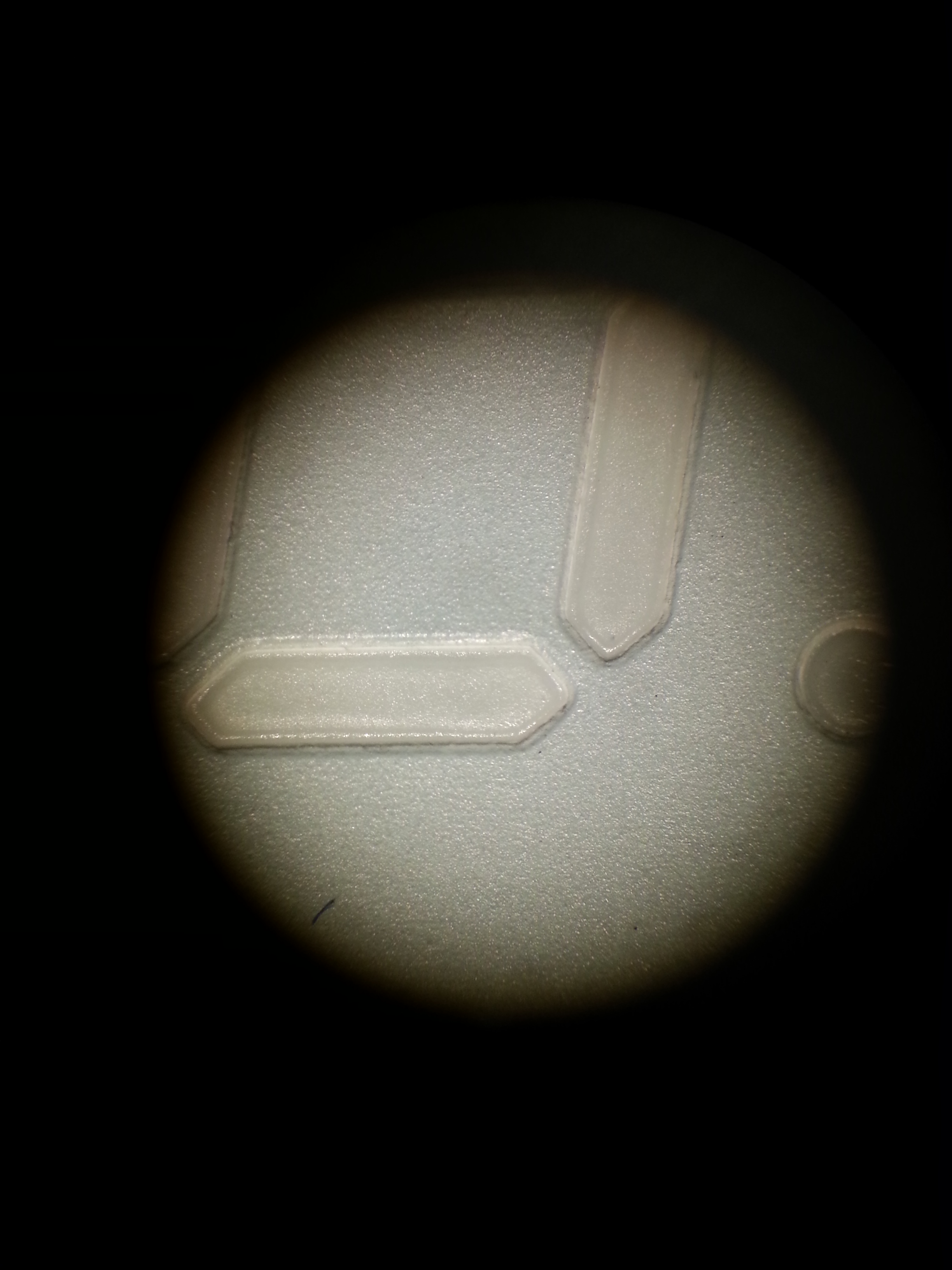
Here is a shot at 30x.  You can see the grain of the plastic!  It is also fantastic for soldering, and checking for shorts in across SMD components.

The adapter makes it easy to take pictures by making sure the camera sensor is where (or near where) your eye normally is when you look at the scope.  If you have ever had trouble looking into a scope (tiny picture, weird black crecents), it’s probably because you were too close or too far away.  The eyepieces help a lot with this, but they don’t fit my phone, which makes it really hard to photograph stuff- hence the adapter.

Now that I have a scope and an adapter, I definitely want to take some 3d stereo-microscopy pictures, and videos of what soldering looks like at 30X.  I think it would be really neat for teaching people to solder SMD components to be able to show exactly what it looks like when solder wicks onto a pad instead of just talking about it.

GelIS Design Thoughts: Cutting Costs

Right now I estimate that the cost breakdown of the box looks something like this:

  • $50 electronics
  • $7 in 1/8″ plastic
  • $4.75 in 1/2″ plastic
  • $10 nuts bolts etc
  • $24 for 12 minutes of laser time, which is currently $2 a minute

This comes out to a total cost, not including my time, of about $100.  This is Kind Of A Bad Thing.  I want to reduce cost, and in to do this, I am going to break the items up into three ways to cut costs.  First are things that can be sourced better, like finding cheaper electronics, or finding a cheaper plastic vendor. The design might have to take into account slightly differently shaped parts, but there is not much I can do to the design to reduce cost here.  The second category are things that can be reduced- using less of something or packing it in on a cut sheet tighter (using sheets of plastic more efficiently) reduces cost.  The third category is reduced labor and time cost, particularly laser time.  A forth category are things I am not willing to compromise on, so I didn’t include it in the enumeration of things I can do.  An example of this are the nylon fasteners in the design- I love them, and they are not going anywhere.

The first category is pretty handily fixed by doing an extensive web search.  I have already started this endeavor and I have ordered a few parts to see if they are high enough quality to use in the box.  If I am successful, I can halve the electronics cost, bringing it down to about $25.

The second and third categories are really important to me, as a designer.  It is my responsibility to reduce the amount of stuff that is used in the box, and make sure it packs nice and tight on the cutsheet.  This means I need to take a hard look at what parts can be made to “stack” better on the cutsheet, and how to cut material out of the box.  However, With the current design it is almost impossible to take anything more out.  Most of the usage of plastic is in the walls, which can’t change in size- they have to fit the power supplies, the meters, and the gel box, and if it was made any smaller it wouldn’t do that.  I have thought of alternate packing configurations, but most of them are somewhat sketchy.

That leaves the cost cutting to reducing manufacturing costs, specifically at the laser cutter.  The thing that needs to be changed is the gel box itself.  If you look at the breakdown of laser time, it looks like this:

  • 5.5 minutes for the tray wall and floor, sometimes requiring a second pass of at least1 minute
  • 1 minute for the transluminator
  • 5.5 minutes for the box parts
  • .5 minutes for the dams

That means in plastic cost, the WHOLE BOX including laser time is about $17.  Just the gel tray costs $15.5.  The gel tray also requires a post-processing step that has to be done on a drill press, which is a no-go if I want to make more than one or two (or 10.  I could drill 10) of these.  Given that the box itself is pretty much maxed out, it looks like I am going to have to milk the gel tray for some savings.
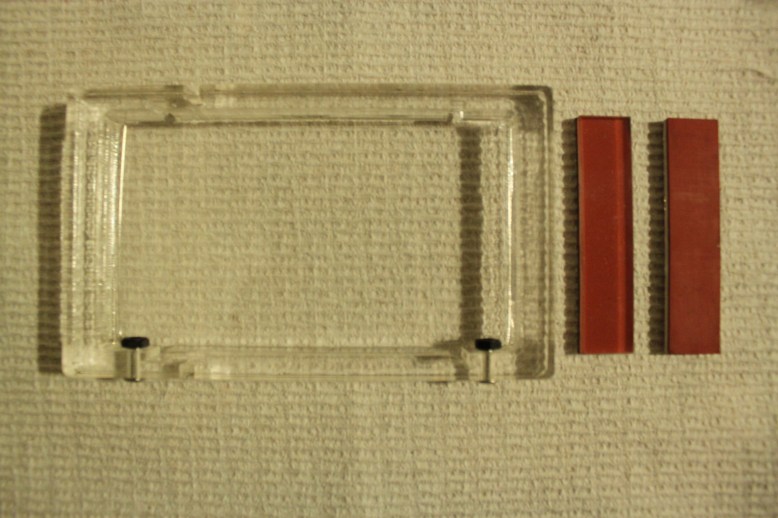
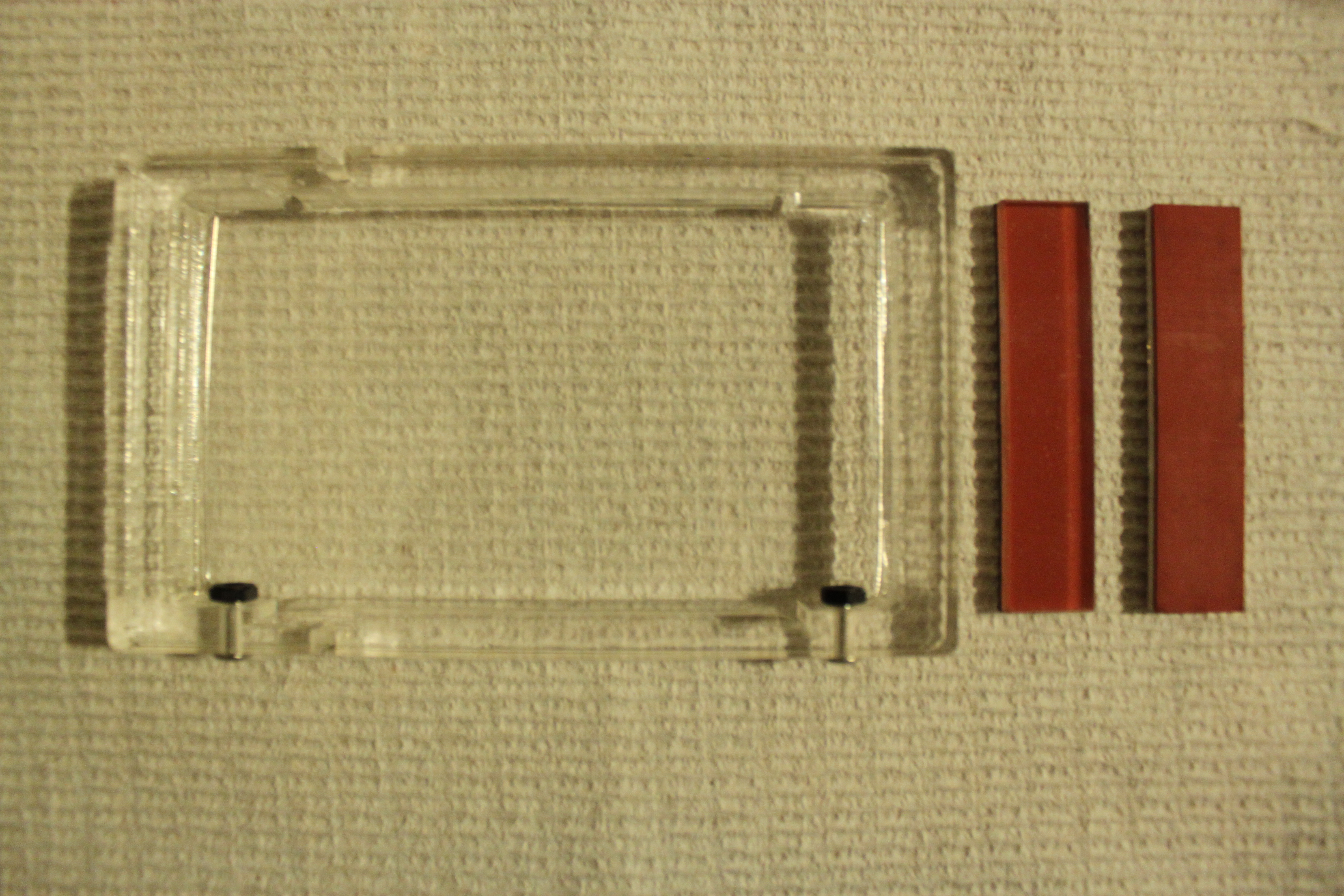
#forgotthecombatthelab? the box, and two dams for pouring the gel.

The gel tray

As I mentioned, there are some things that can’t go, like the electrodes or the dams.  Some things need to go, like the holes that the screws go through in this picture.  I think the answer is to look back at a past prototype.
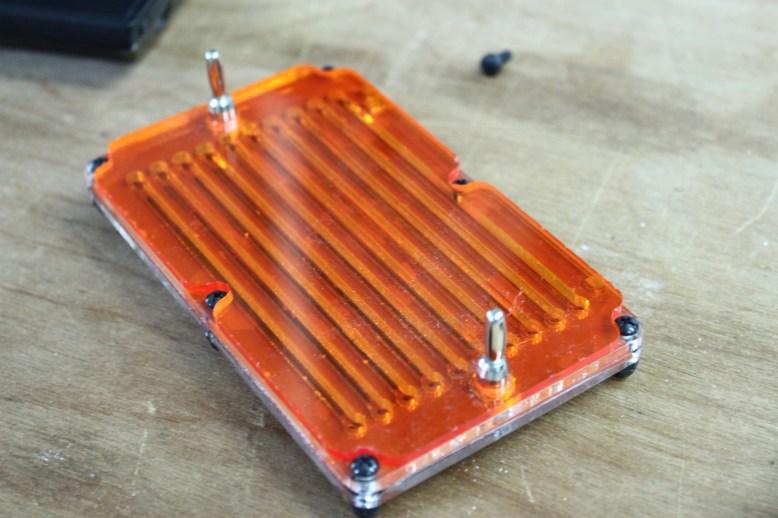
Prototype 0

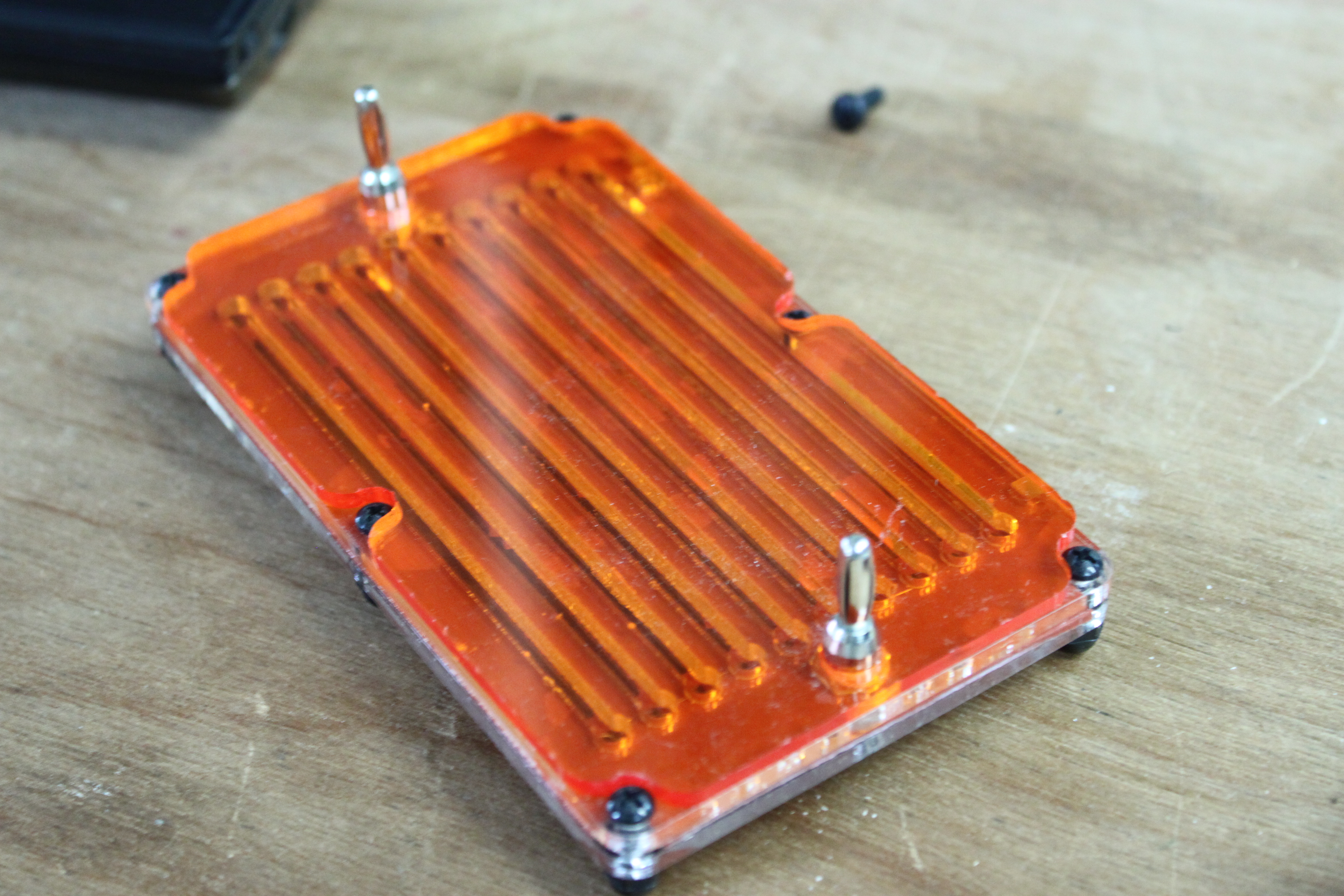
Prototype #0

This is version 0 of the gel box.  There was actually a version -1, but that was so long ago I didn’t count it.  This box used approximately 10ml of gel in 10 lanes, and used maybe 2ml of buffer.  The goal here was to reduce the amount of material that needed to go into the gel, and make it so you could select how many lanes to run.  It worked ok for things like food dye, and I even ran DNA in it once. However, there was a major problem with this box, which was the electrode choice.  It was too thin (~.003″), which made it difficult to rout, and even then the rubber couldn’t seal around it, so there was really no upside.  Also, bubbles would form on it, and in the thin channels, this would block the buffer from reaching the electrodes, which made the gel run unevenly.

However, it shows that you can have a really thin gel that still works.  Those gels were less than .118″ thick.  There have been papers published on ultra-thin gels(as thin as .01x.1×7 mm in size!, G.T. Matioli, H.B. Niewisch, Science, 150 (1965), p. 1824)), so maybe I can make it cheaper by thinning the portion that holds the gel.  But to do that, I need to eliminate the holes on the side of the box (which I will be happy to do!).

So I want to try something like box 0, in that it is shallow, and like box 2, in that it is functional.  To get rid of the holes in the side, I am going to add in-cut plane holes for bolts, just like in box 0 for the banana plugs.  These will go to metal screws that will probably go through the box, into one of my favorite fasteners of all time, the 6/6 nylon 4-40 acorn nut.  These acorn nuts will slip into holes in the bottom of the gel tray so you know the tray is in the right place and they will help keep it there.  Of course, there will be a small grove on the top and bottom of the box (the part that holds the tray) so you can grab the side of the tray out, but the fit will be tight so there is little chance of electrocution (as small as you can expect with a regular gel box).

Even if this only cuts the cost of the tray in half laser time-wise, it is still a simpler, better way to build the gel tray, and the plastic to build it is more readily available and much cheaper.  Since it is cheaper/better, it will make it cheaper to have more trays, which means you can save your gels/precast your gels, and not have to worry!  Look for this in prototype #3!