Verified working Lightbulb PCR!

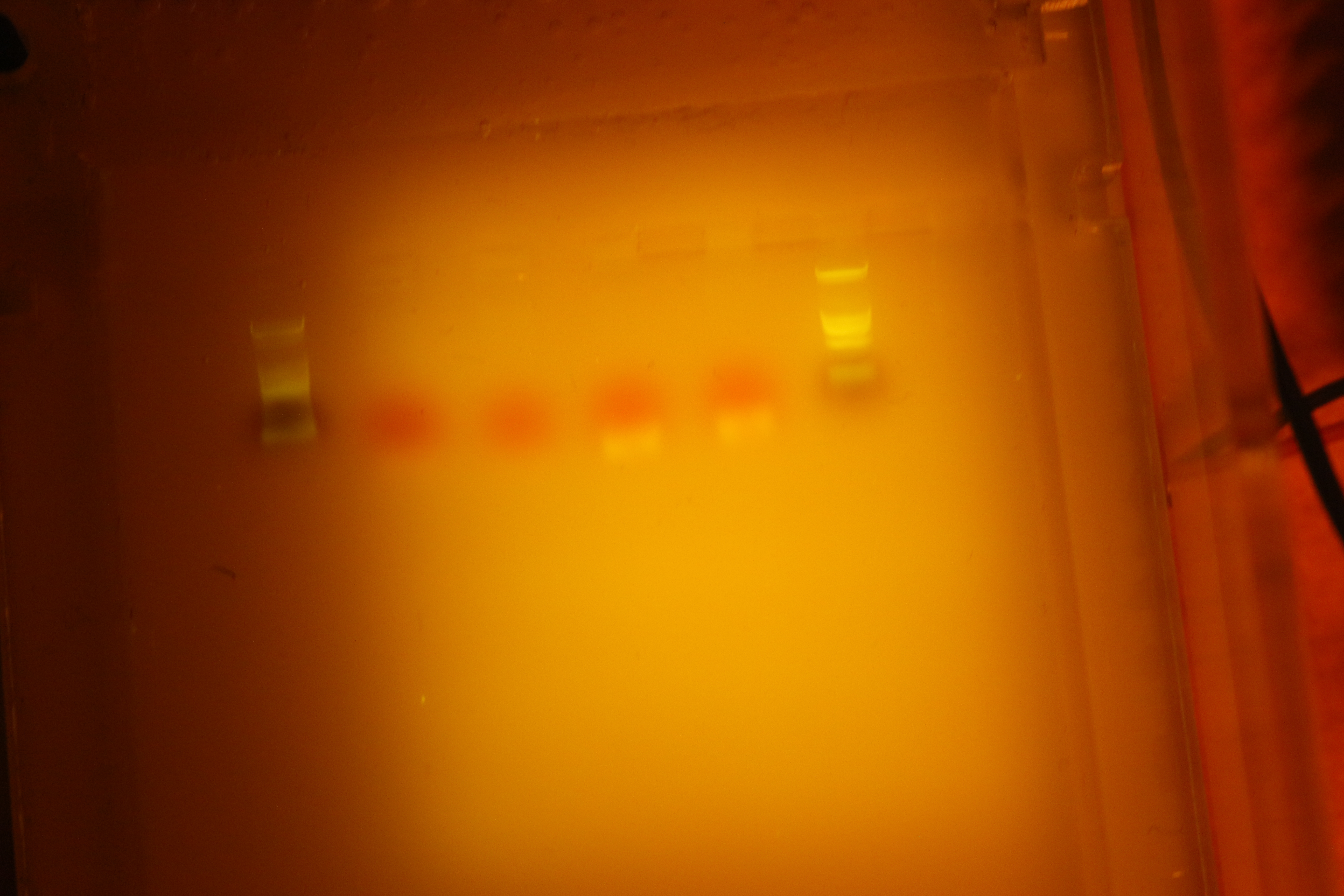
L to R: ladder, neg control, neg control, positive, positive, ladder (diff conc)

L to R: ladder, neg control, neg control, positive, positive, ladder (diff conc)

Lightbulb PCR has been kind of pipe dream of diybio.  Today, I finished off the build started at Bosslab, and confirmed the results via gel electrophoresis on a torn-down GELIS box.  What you see above in the right-most red lanes are the real deal- amplified DNA (ladders with blue dye on outside, red with no dna is negative control.  Technical details will follow soon but I really need to hit the hay.  In lieu of documentation, here is what is known about the concept of lightbulb pcr.

There has been, to my knowledge, only one confirmed working build, which was done by Brian Blais.  You can see the work here. The title of the work is “A Programmable $25 Thermal Cycler for PCR”, in case that link goes dead.  It was done back in the day when the hardware was an Intel 486 with 8 M of ram!  With a parallel port!

This style of PCR machine was resurrected circa 2011 when Russel Durrett did a build using PVC, a computer fan, and a lightbulb all controlled by an arduino.  Theoretically it was a good build, but I never saw actual results, which discouraged me from building it, due to the physical constraints of the system.  The issues stem from the use of air as a conductor of heat to the samples, a lack of heated lids and a lack of sub ambient cooling.

Using air as a conductor is really a killer, since heat distribution can be influenced by the lightbulb sitting at an angle, or air currents in the room.  Air is really not a good conductor, and this means that the feedback sensor is at a different temperature than the sample, which is no good.

At the same time, it is a brilliant build because literally all the parts can be found either at a hardware store, or at a hobby electronics type store.  And it works.  Maybe not reliably, but it works and it is cheap, so that is a good start on a tool, if someone is willing to invest the time.

Anyway, a post tomorrow will have a rough BOM, electrical schematics, and code.

Refrigeubator?

IMG_4916

Incubator.  Refrigerator.  Both actually, and connected (and configurable) over http to the LAN.

The project, whatever it will finally be called, is coming together.  In the past two days I got the relays wired up and tested, the temperature sensors hooked up, wrote the logic for controlling temperature, and made it so you can post a new setpoint via the website hosted on the pi.  This is actually a big deal because it can be used as a framework to access the pi’s GPIO over the LAN, or potentially over the web (provided there was an intermediate server).  I am sure people have done this, but it is good experience to do it, and it is fun.  This could be good for home/lab (is there a difference?) automation or a slew of other projects!

The last few details to attend to before testing with cells are to:

  • mount the sensors and electronics to the structure of the fridge
  • add some lights inside so you can see when you take a picture
  • shakedown for 48 hours or so
OJ-SH105DM relay bank

OJ-SH105DM relay bank

These are the relays.  I chose on/off relays over FETs or some kind of proportional control because they should make less heat (very low ‘Rds on’ in FET terminology), and because the temperature inside is not particularly critical, so on/off control should work ok.  Plus, the code would be easier to implement on the pi, since it would only need two digital io pins, instead of a separate DAC.  They are arranged in kind of an H-Bridge configuration for reversing (or turning off) the flow of current through the peltiers.  The screw terminals make it easy to wire to the peltiers, which are stuck into the cooler.  Air-soldering this thing on would have been a huge pain and I probably would have ended with some holes melted into the incubator.

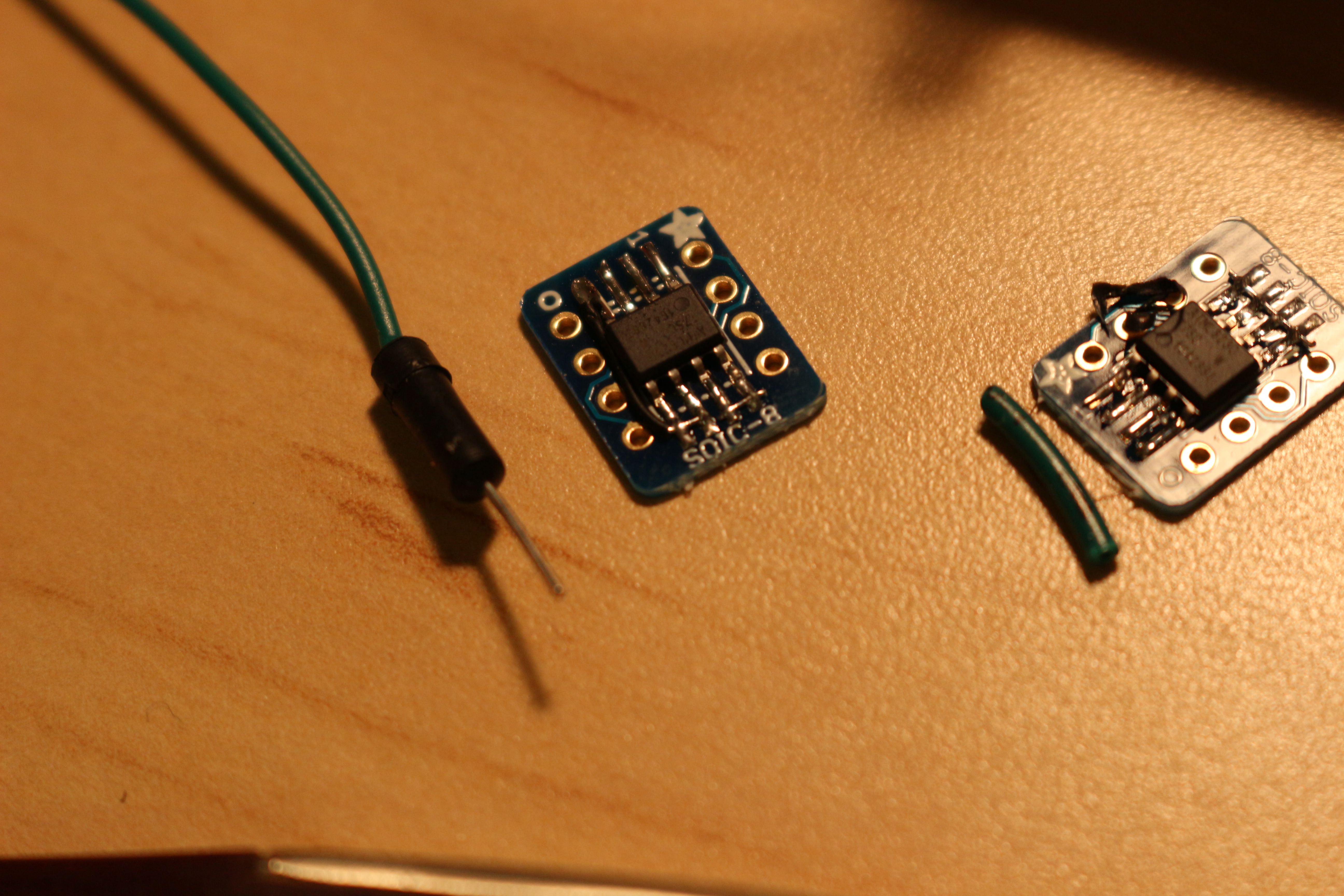
IMG_4913These are the sensors I am using.  They are AT30TS750 temperature sensors by Atmel (I like them).  They have up to 9-12 bit precision, and talk over I2C.  Unlike he potentially useless and annoying one wire sensors, which each have a hard-coded ID address, these are user-selectable with jumpers to pins 5-7.  So I can set “inside sensor” to be 0b1001111 and then if I build 3 more of these, I don’t have to spend time correlating the address to the location.

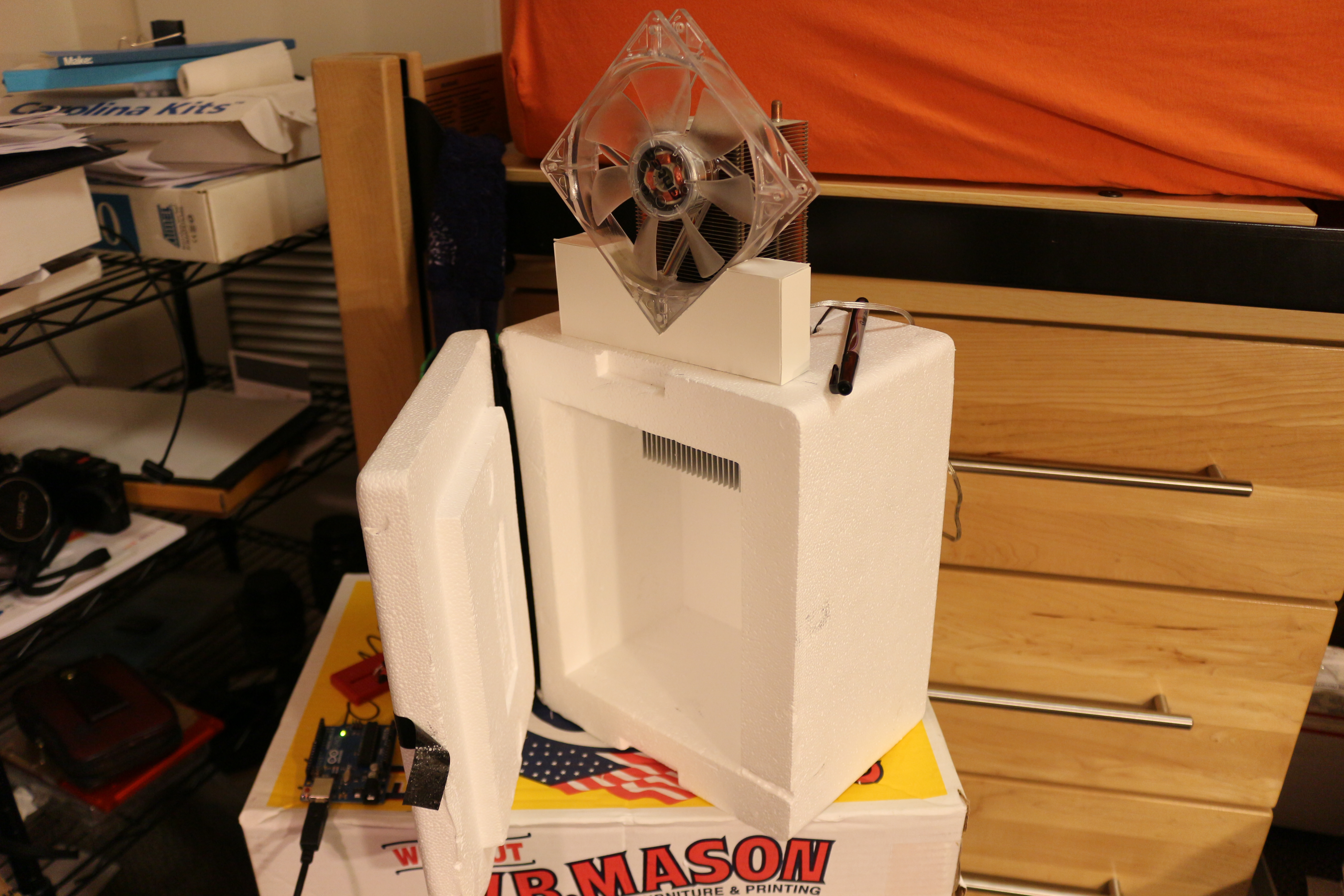
IMG_4917This is the state of the incubator.  It has moved from ugly styrofoam container to slightly more functional ugly foam container.  One nice thing about the foam is it is easy to cut it to make channels for wires.  The hope is to give it a decent finish with foam-core (just for looks), plastic or MDF once it is done which will hide the foam, although that will depend on how much I like it.  Another thing to check out is the new fan and fan support.  The support is made of foam core, which is a material I really like.  It can make lightweight structural elements like the support in a pinch, and it looks clean (provided you are careful).  For this application it was much faster than 3d printing, and easy to work with without large tools (unlike sheet metal).  One of the next steps is to move all the wiring to the back of the box.

note: The arduino is there just because I was playing with the cc3000 module- it is not related to the project.

IMG_4902I added this picture because it shows the tiny workspace I use to fab this stuff.  Even with a small space you can get stuff done.

Celery Causing Out of Memory with OpenCv

Recently I posted about using openCV to grab webcam images on a pi.  The problem turned out not to be the limited memory, but how I was using celery and opencv.  Basically, there was a memory leak.  On my laptop this occurred as well, but at a much slower pace.  On the pi, the poor computer very rapidly ran out of memory.

The setup was that there was a celery task (posted below), which was set in celleryconfig to run every 10 seconds or so.

@app.task
def getwebcamimage():
    logger.debug(“capturing image attempt…”)
    c = cv2.VideoCapture(0)
    for i in range(10):
        flag, frame=c.read()
    flag, frame = c.read()
    cv2.imwrite(PATH_TO_IMG,frame)
    logger.debug(‘saved image…hopefully’)
    c.release()
    return 0

I would start celery beat with

$ celery -B -A celerytest worker –loglevel=DEBUG”

The problem has something to do with how celery/python treats objects that are created inside of tasks.  Each time, python was creating a cv2.VideoCapture object, but cv2.VideoCaptue.release() doesen’t seem to release the object- instead it releases the lock on the camera and keeps the object because it might be needed later.  I used the Top command to look at how processes were using the memory, and the memory for celery would grow out of control.  Bad.

The solution I came up with was just to run two threads- the server in one, and an image updater in the other.  This is nice because the cv2.VideoCapture object is only made once, and it can run independently of celery.  Just to make sure I had actually found the error, I tried running the same code from the celery task in a thread alongside the server, and I got the same kind of memory leak.  So it was not celery related, but jut python not giving up memory, which caused the celery task to OOM.

The new code snippets look like this:

def get_image():
    c = cv2.VideoCapture(0)  #make videocapture object
    while 1:                              #capture frame ever 5s
        sleep(5)
        print(“getting image!”)
        for i in range(10):        #let camera adjust*
            flag, frame=c.read()
         flag, frame = c.read()
        cv2.imwrite(PATH,frame)

    try:
        thread.start_new_thread(app.run,())#start server
        thread.start_new_thread(get_image,())
    except:
        print(“unable to start thread”)
    while 1:
        pass

*Note: my webcam seems to take some time to wake up between accesses, so I read a few frames before capturing the final image.

Using OpenCV with a USB Webcam on a Pi

openCV errors on the pi:

libv4l2 error allocation conversion buffer

select timeout

The title of this is constructed to (hopefully) make it easy to find this for people who are having this issue with opencv on a system with not a lot of memory.  I have moved the celery/flask code over to an actual pi, and this has caused some problems.  I have been using celery to run a little python script every minute to grab an image from a webcam, save it, and then release the webcam.

I would normally get some kind of error with libv4l2.  I have found this post very useful, and this blog entry is just to make this very valuable post more visible.  The solution seems to be to allocate more memory to the ARM processor in raspi-config memory split menu.  You can run raspi-config with:

$sudo raspi-config

This error can also be stopped by basically telling the memory management system to lie and say it always has enough memory.  This can be done with:

$sysctl vm.overcommit_memory=1

and undone with:

$sysctl vm.overcommit_memory=0

which you would want to do if you actually do run low on memory (this is all paraphrased from the link!)

Edit:

The above was helpful with the lib4l2 error but I was still getting select timeout errors when requesting frames.  This post explains how to fix it by running these bash commands:

$sudo rmmod uvcvideo

$sudo modprobe uvcvideo nodrop=1 timeout=5000 quirk=0x80

I will add more fixes if I have issues, but these links should really all be in one place.

Internet Enabled Incubator Progress

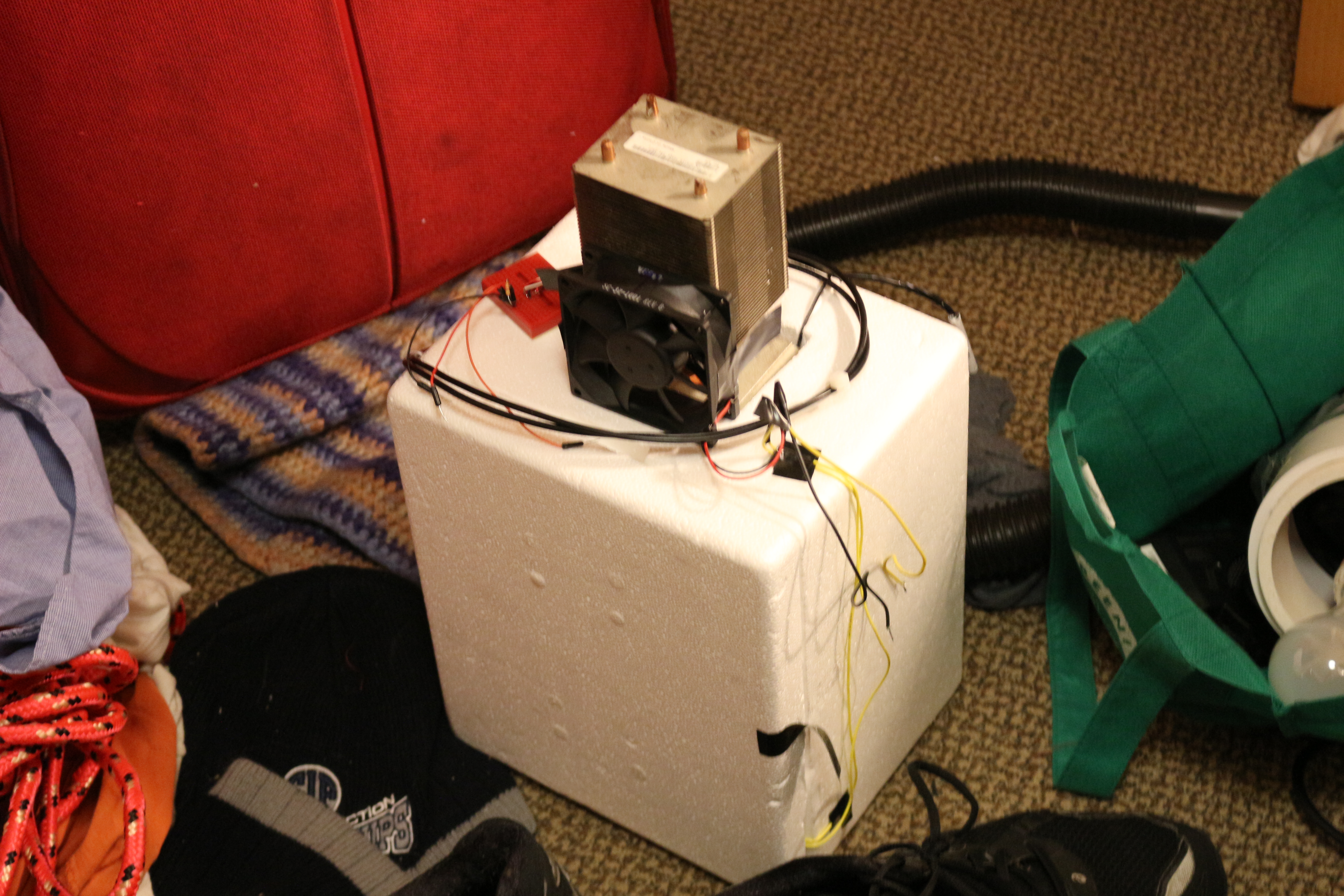
The incubator is hanging out on my floor

The incubator is hanging out on my floor

Incubators have bad UX

Springtime is here, and another ambitious biology project is in the air.  I had a lot of fun redesigning the gel box experience, and so I am going to be doing a few more biology equipment projects.  The first of which is an networked bacterial incubator.

However, is no mere incubator.  This is an incubator re-imagined to be less horrible to use.  Right now the steps to use an incubator are generally:

  1. Put plate of cells in incubator
  2. Hope that it is at the right temperature
  3. Check if colonies have grown yet
  4. Repeat until the colonies have grown, or overgrown

The problem here is that some poor soul (grad student) has to physically go to the incubator, and look at the plates and see if they are overgrown.  If you think it will take 6 hours, and you put the cells in at 6 pm on Friday, that means you have to visit at midnight on Saturday morning, probably in a deserted building.  Being in the lab alone is a bad idea.  Rinse and repeat.  That’s like going to the post office every hour or so to check if you got mail- it is a silly thing to do.  Besides being silly, there are better things to do on Friday nights.

Redesigned Experience

The main things to fix in the incubator experience are:

  • Having to go look at the cells at weird times
  • Logging temperature data
  • Logging growth data

The first point has been explained.  The last two are to add security and debug features to the incubation process.  This way you know if someone cranked up the heat, or left the door to the incubator open, and what the actual temperature is in case there is a problem.

Technical Solution

If you look at the incubator above, you will notice that it has a huge heat sink sticking out of the top.  This is because this incubator can achieve sub-ambient temperatures down to about 2C, thanks to some peltier modules.  This means you can have your cells happy and growing at full tilt at 37 C, and when you want to stop them, you can just turn the whole thing into a fridge.  This means you don’t have to harvest the cells right away- but someone still has to make the call to flip the switch.  To do this, they need a picture of the cells, and a button to press.
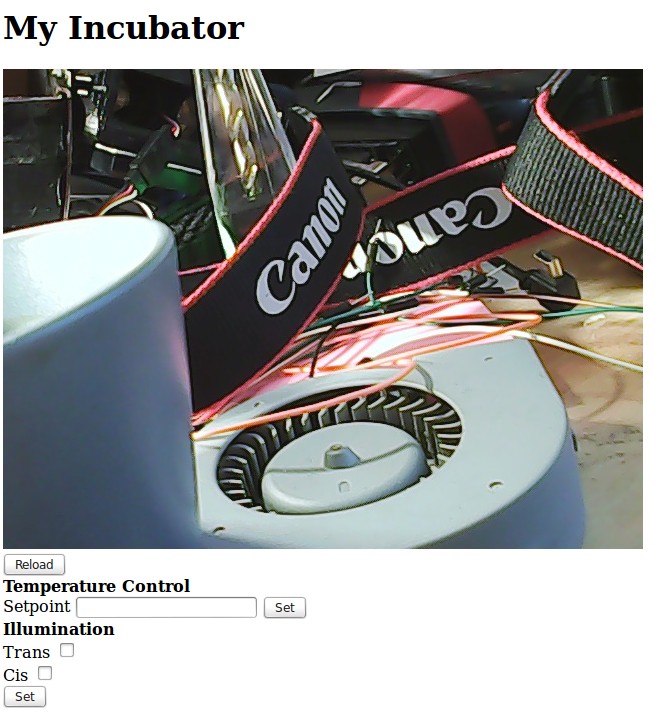
quick and dirty server with inputs for lighting and temperature

quick and dirty server with inputs for lighting and temperature.  Pointed at my messy desk right now

The solution of course is to make the switch-flipping and picture-viewing happen remotely, via a webpage or an app.  This is easier said than done, because of network security.  As I understand it, if I wanted to host a website on my computer or any device connected to the wireless at school, I would have to go and ask IT to set up port forwarding from our public IP address to my computer.  This would let the routers know that if someone is making an http request on port xxx, send the traffic to my computer.  IT is not likely to approve this request.

Fortunately, if you have an internet connection it is easy to “dial out”- for example, you are reading this blog right now, which is on another computer.  However, this website can’t just go around accessing files on your computer, which is a good thing for you!

The solution that seems to have taken hold is to have an intermediate platform hosted on remote server that talks to both devices.  An example of this is the spark core cloud, which seems to be used to mediate data transmission to/from sparks and computers.  I don’t like this because it adds an extra link and complexity in the connection between people and data.

The Progress So Far

Electrically and physically, the incubator works.  This is more of an exercise in hacking together a connected device, so most of the hard parts for me are code and networking related.  So far I have done a few things that I have never done before: write a server in flask-celery, template in jinja, and write an android app!  I have to say they are probably not the finest shining examples of code, but it works.

The server will be deployed on a raspberry pi that will be connected to my LAN.  The server has a page that has an up to date webcam image on it and button to refresh, and has an interface for getting data from html POST/GET to python code running on the server.  There will also be an API for talking to it from other applications.  The nice thing is that if I ever get control of my own router, I can set up port forwarding and it will be online for me to access anywhere.

One possibility is to have an android app for remotely monitoring the incubator.  It would be nice to have it on your phone or tablet for when you are out and about.  To this end I have tested an app that can post or get things from olins mobileproto twitter server.

I chose to use an http server and a pi, as opposed to maybe an arduino and a cc3000 because it gives me a little extra juice in the memory, power, and i/o departments.  In particular, it has wired ethernet, USB support, and GPIO.  This means it could be useful in other projects down the line.  Normally I go with the barebones implementation but in this case the extra power can provide something like openCV, which could be useful to process the image, and I can use a nice webcam instead of a serial camera.  Also, it can talk to other micros that might actually manage temperature control on a separate power bus.  The pi is not a RTOS, so if it gets tied up or DDOSed or something, I really don’t want it to forget that the incubator needs to be switched off- therefore some kind of micro go-between is not a bad idea.
Thing-O-Matic Design Notes

Note: This post is a bit dated since I started it in October of ’13, but as I turn to my TOM for a few more prints it is once again relevant, so I finally got some photos and posted it.

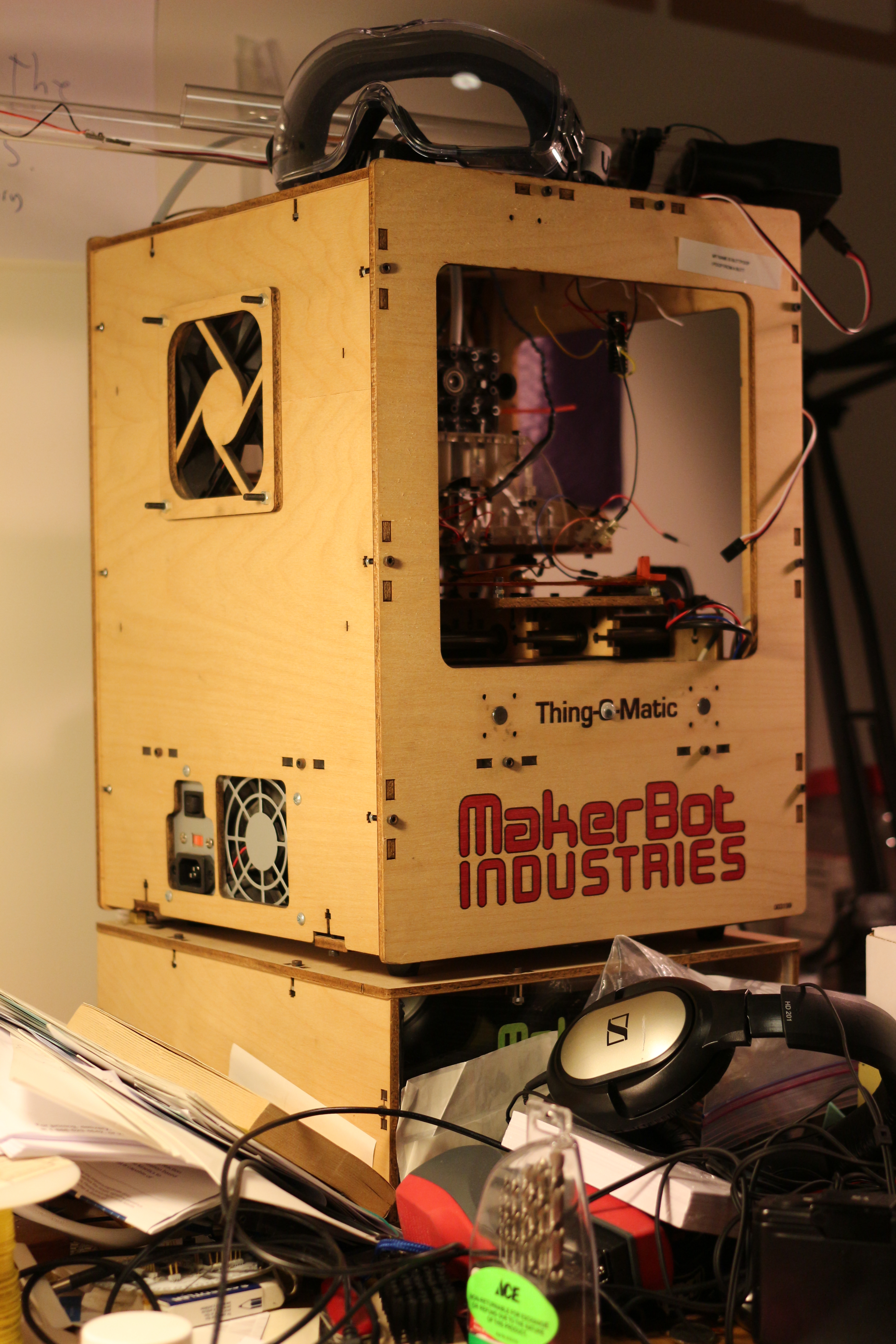
Ye Olde Thing O Matic

Ye Olde Thing O Matic, complete with cruft

If this post had a parenthetical addition to the title, it would be “(Or, how I came to loathe T-nut connections.)”.  I recently took apart the XY stage of my Thing-O-Matic to service it- I am the second owner and the original assembler had neglected to properly set the height of one of the pulleys, or possibly the pulley wiggled off the shaft.  Therefore, the belt rubbed on the platform and it had started to deteriorate.  Unfortunately, people (in particular, whoever is responsible for the TOM) have made some design errors in executing the T nut connection, and in material choice.

IMG_4888

The underside of the build platform

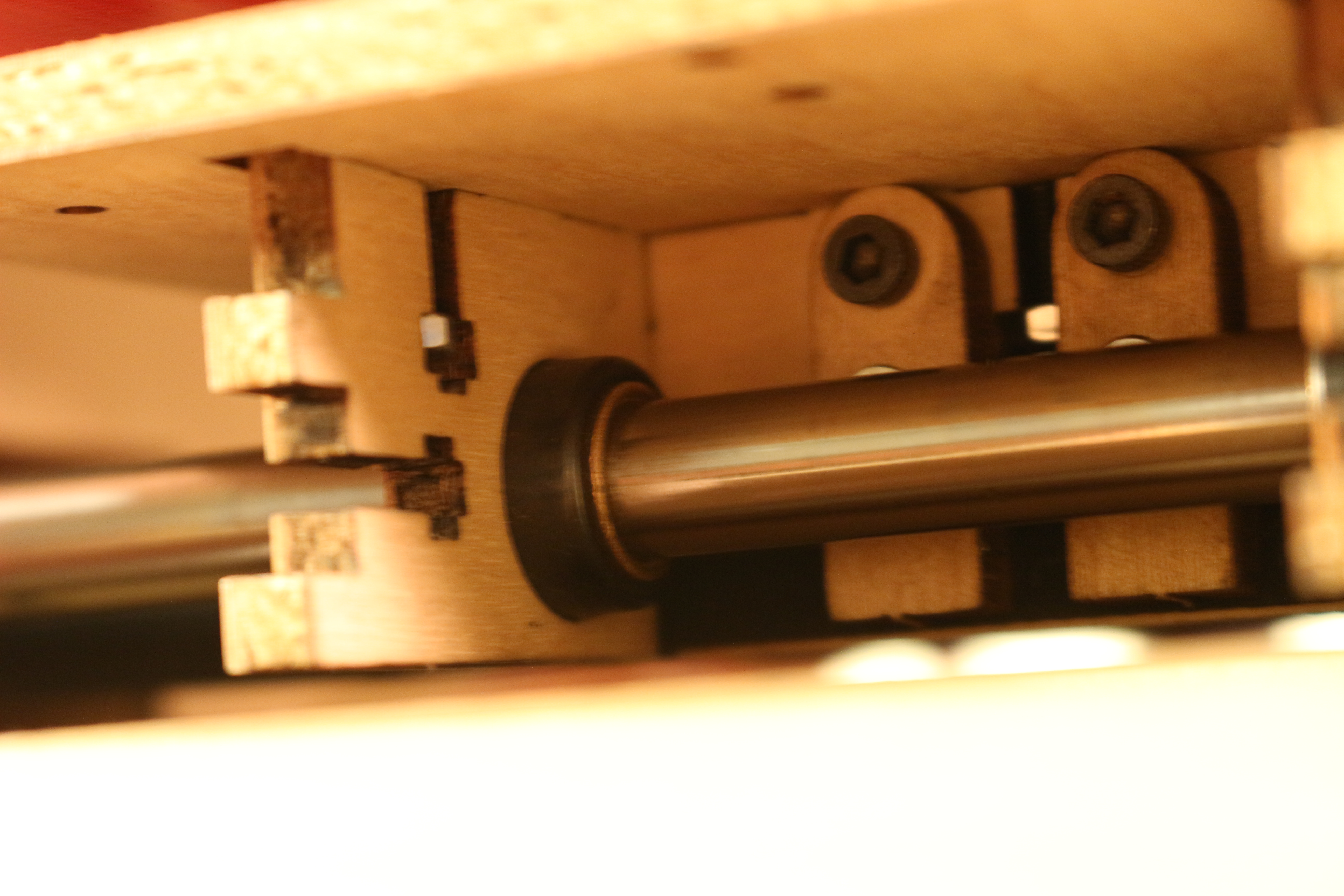
My biggest gripe with the T nuts on the TOM is that most of them are placed in absolutely impossible to reach places.  This machine was not designed to be serviced, ever.  some of the steps stack so that  the only way to re-assemble the machine is to completely disassemble the XY stage.  This makes it a pain to adjust or replace belts, or even to do cleaning.

IMG_4898

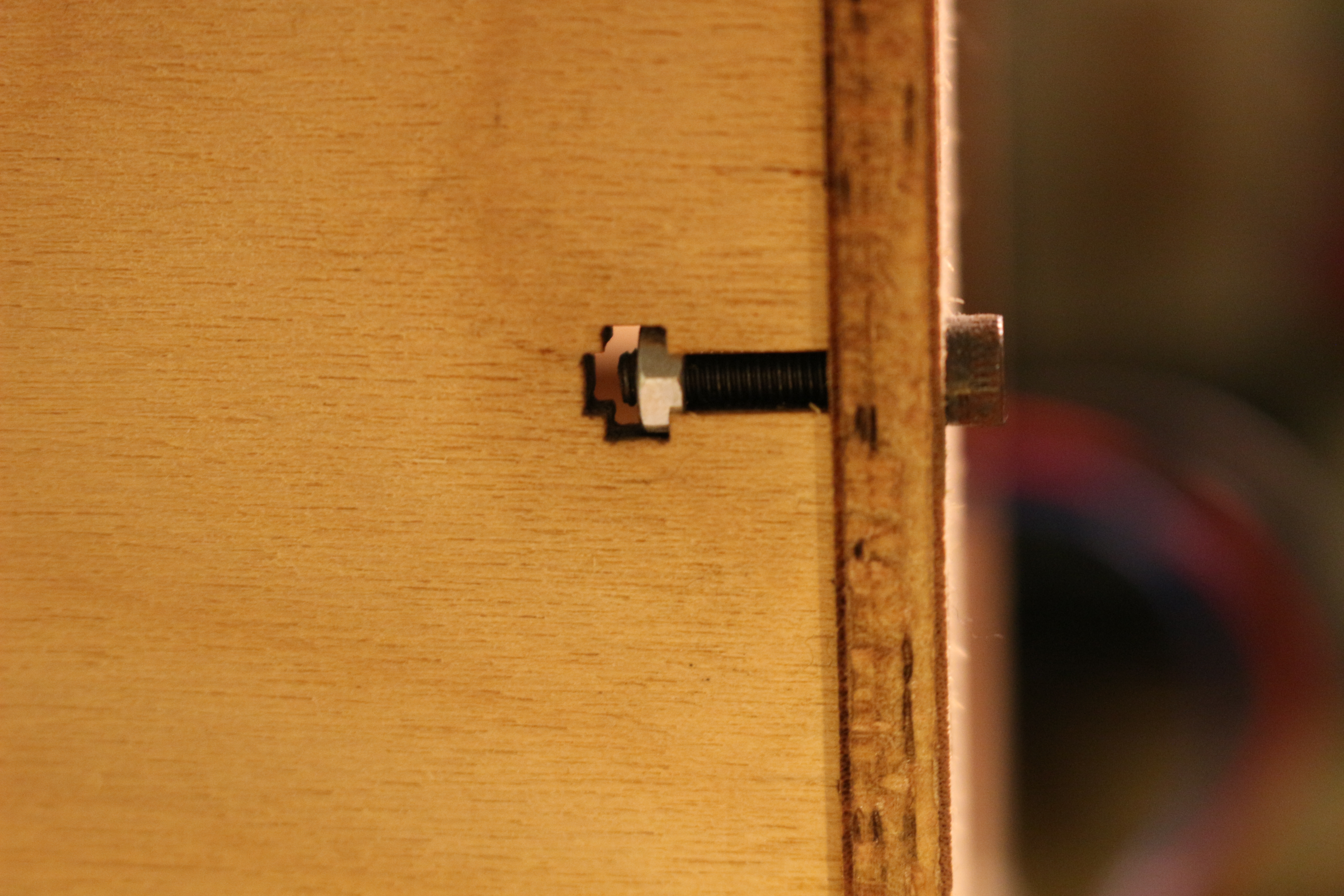
A properly connected t-nut connection

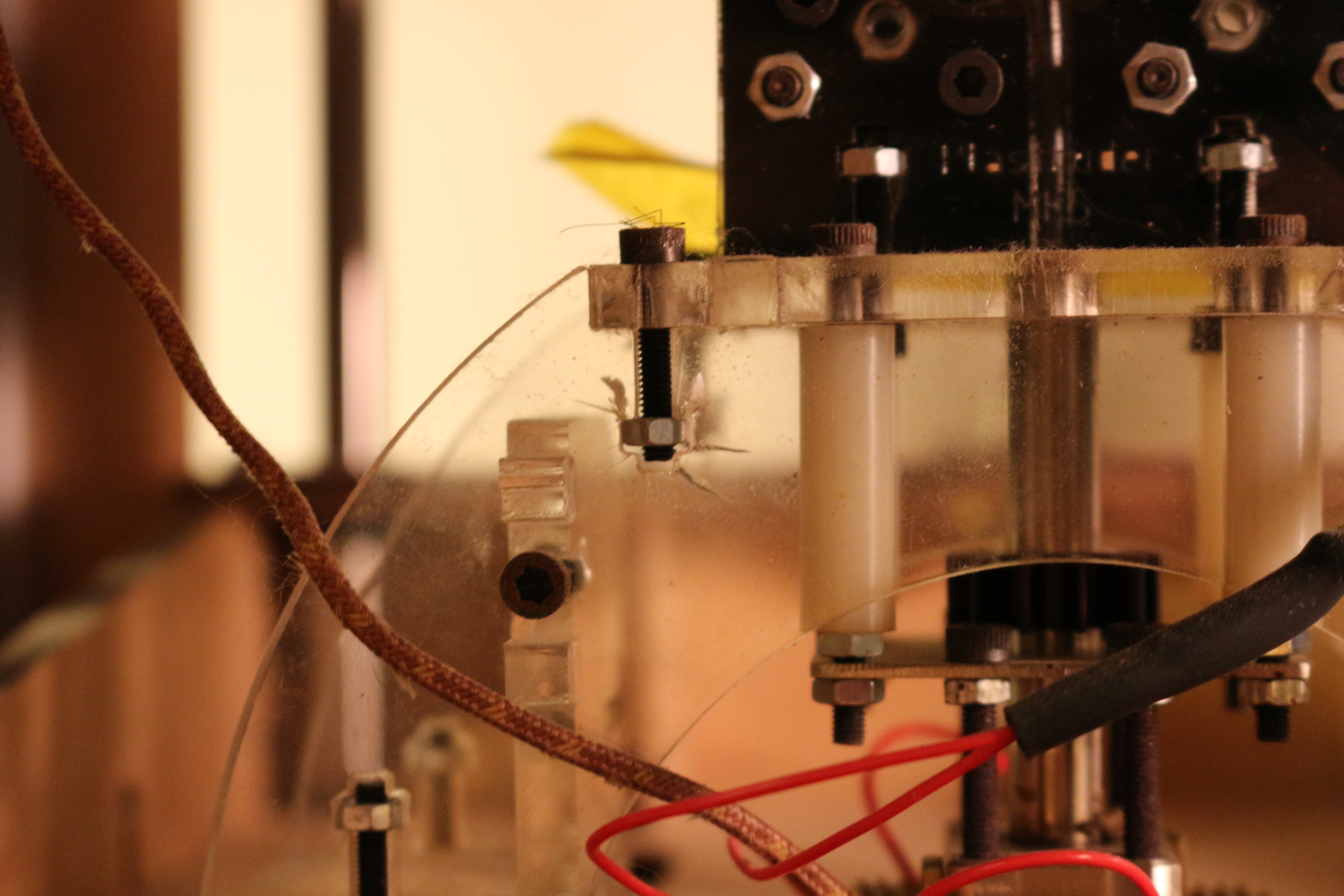
The biggest error Makerbot made was not lasering the holes to be clearance holes.  This means that the nuts “thread” into the wood.  They don’t really leave threads, but the connection is quite firm.  The problem here is that the extra “threads” create a constraint the bolt so that when it enters the nut, it is not free to rotate and find the start of the threads in the nut.  The nut is similarly constrained by the T slot to have to rotate in 30 degree increments.  This occasionally makes it impossible to thread the nut onto the bolt, since the bolt is threaded into the wood as well. It is very difficult to get parts to sit flush with this extra constraint.  An easy experiment to try is to hold two nuts flush with each other, with the hex faces matched up, and then try to thread a bolt through them in that configuration.  Normally, you get a few threads between them, and that distance will remain no matter how much you tighten the bolt.

Improper "set screw" configuration

Improper “set screw” configuration

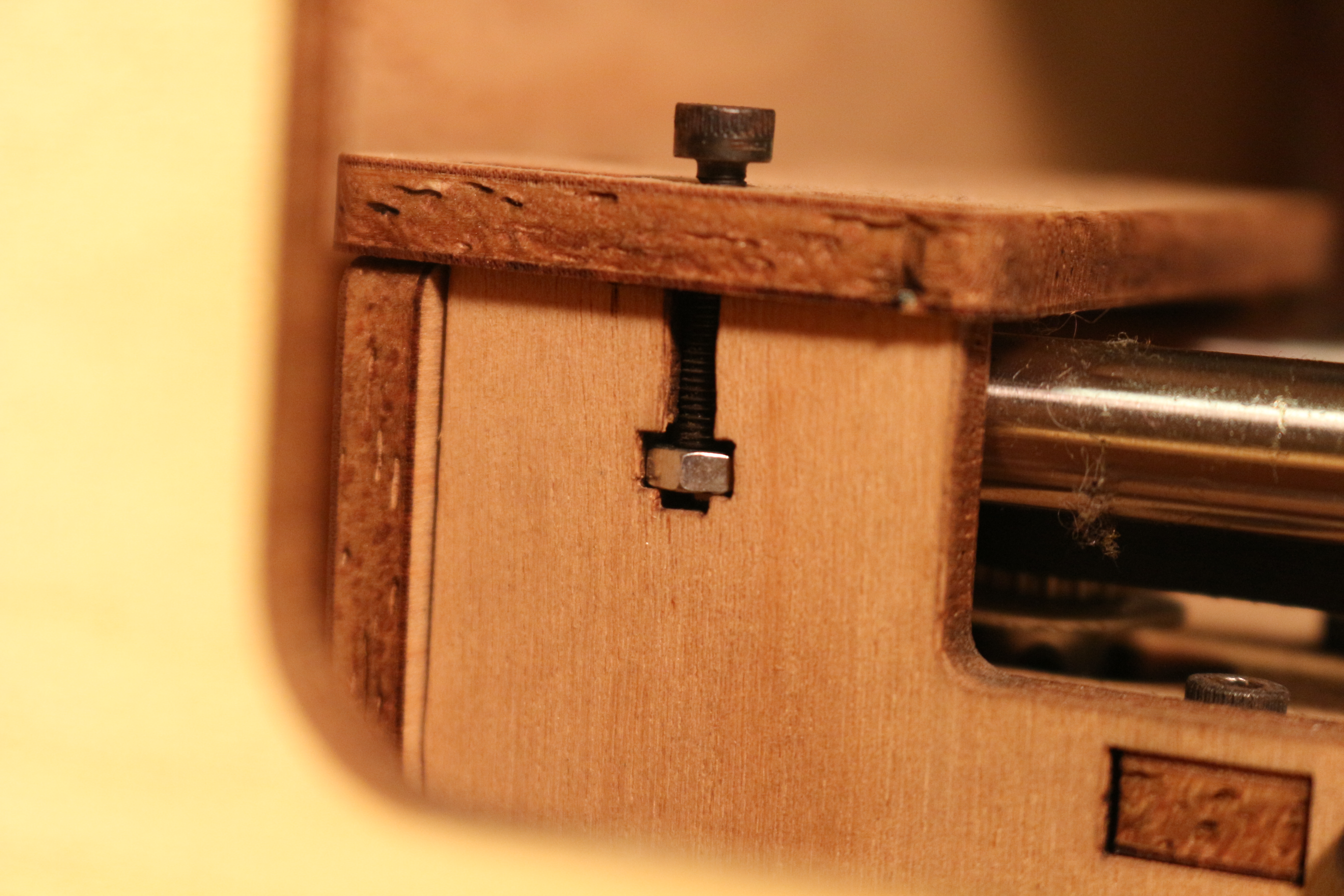
This extra constraint leads to the next problem, which is the T nut as a set screw.  If you are not careful, the bolt can thread into the wood, and press the nut against the bottom of the T slot.  This creates a problem because now the bolt is actually pushing out on the wood you are trying to push in.  It can be hard to tell when this happens because of the first problem, which is that there are T nuts in deep, dark, impossible to reach recesses of the ‘bot.  And it is only a matter of time until the wood swells, or the nut rattles free, and then that T connection is no more (or more importantly, there is now a nut and bolt trying to jam your axis).

IMG_4890

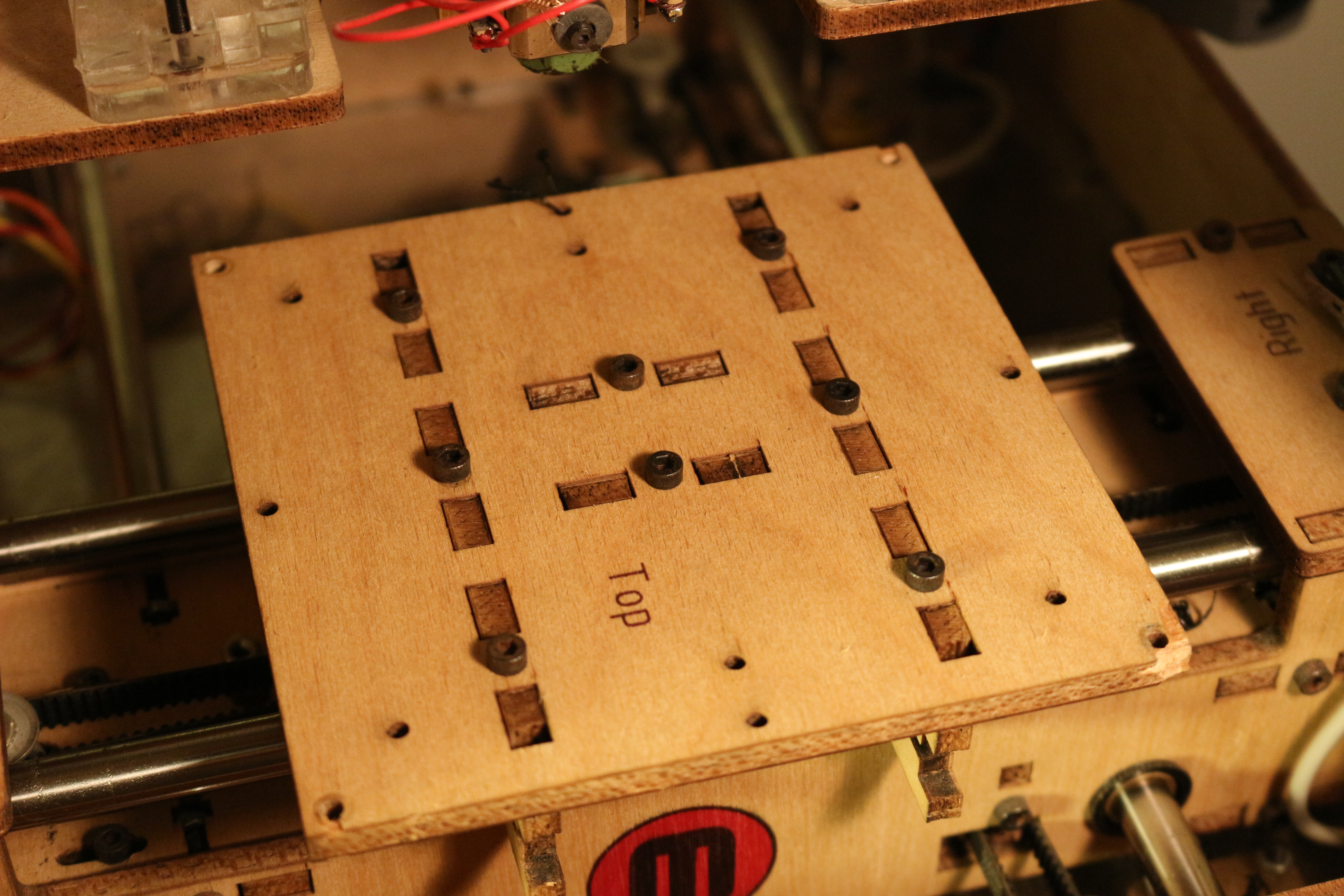
On top of all this, Makerbot also ridiculously overdid things that were T slotted.  This is a 3d printer- that means there is basically no force up on the table in the Z axis (or really any force downwards, other than gravity).  The build platform is held on by no less than 8 T nuts.  These nuts are in tiny nooks and crannies.  The build platform is actually fixed not by the nuts, but by gigantic mortise and tenon joints.  MBI could have nixed most or all of the nuts in favor of letting gravity do its thing and hold the joint together, but opted for T slots upon T slots.  This introduces a manufacturing problem because it means that the holes have to be even more accurate, as the holes for the T nuts have to line up.  This is easy to achieve with laser cutting, but it is a small waste of laser time.

IMG_4886

Keerrack

My final gripe is the use of acrylic to hold up the hot end.  Acrylic is pretty tough, but the sharp stress concentrating corners on the T connections inevitably lead to cracking, which is not surprising.

I could go on and on, but much like cameras, the best 3d printer is the one you have with you!

Sketching Supply Holster

IMG_4878

Sticky tape not shown- normally I tuck it under the closure


I have started to carry a few more supplies around for better sketching, and I wanted to help prevent them from getting lost in my bag or from poking a hole in it.  The things I wanted to carry were a ruler, scissors, and double sided sticky tape.  They are quite handy for making scale drawings and adding/subtracting things from various notebooks.

I also wanted to visit a fabrication technique that I had not used in a few years: sewing.  To keep things simple, I decided to use only fabric and thread to make my holster.  No webbing, no D-rings or buckles, just fabric.  So I went out and grabbed some cheapish canvas, borrowed a sewing machine and got cracking.

IMG_4865

I started with some sketches, inspired by EMT scissor holsters.  Some of these are very elegant, in that they only use webbing folded over itself to create the pockets.  For a while, I actually used the cardboard model to carry the scissors around in.  It worked well, but it lacked pockets.

IMG_4868

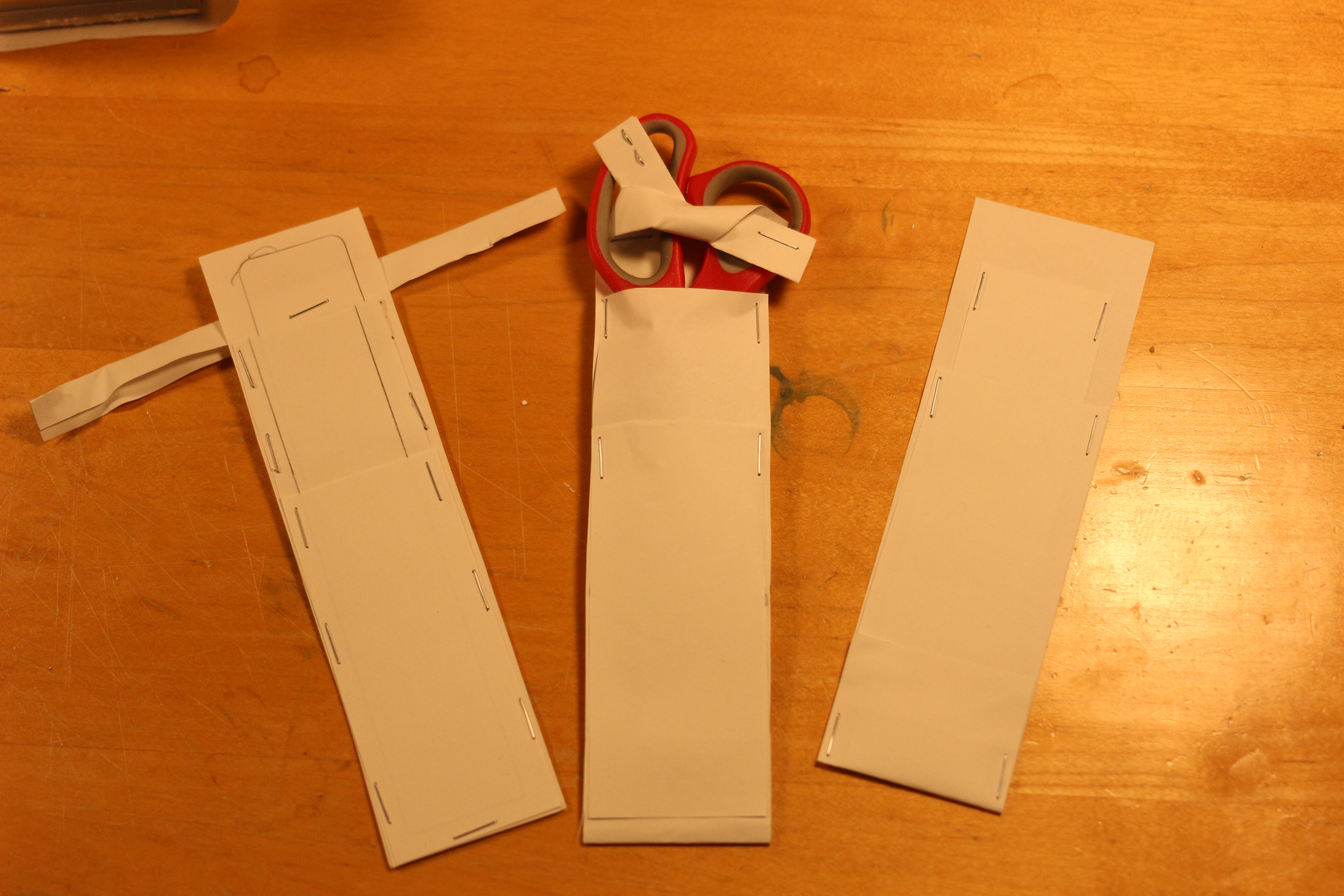
Then I moved to some paper models.  One thing these did not capture was where, and in what direction seams would be.  A few of them left raw fabric edges, which are undesirable.  It might work with webbing, but not with the canvas I had- it would unravel.

IMG_4870

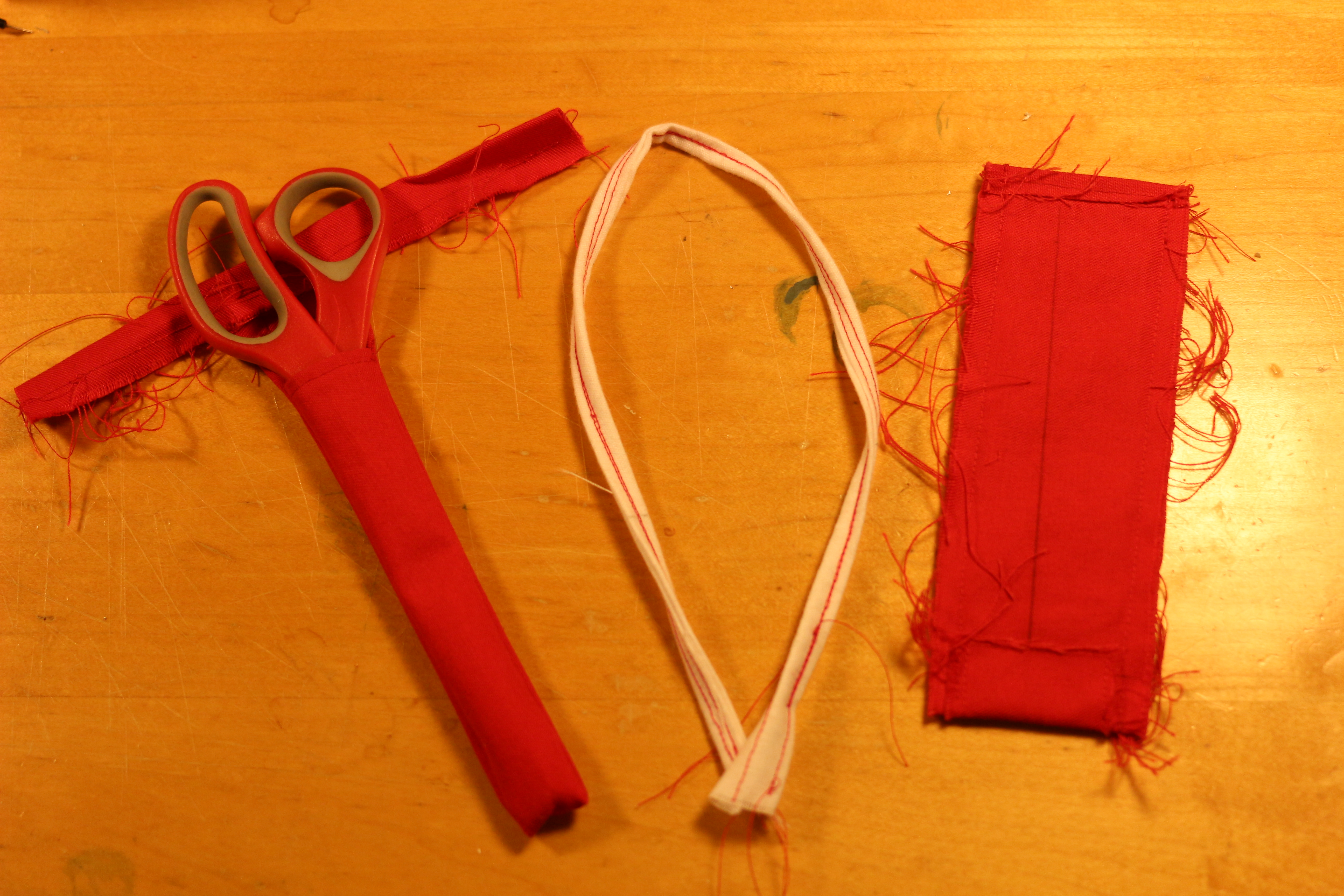
After some sewing I figured out how to make straps where all the edges were internal.  I would have preferred to sew a long tube and flip it inside out, but the aspect ratio was not condusive to this.  Notice the extra reinforcement on the bottom of the rightmost prototype.  This was added to prevent the potentially pointy scissors from puncturing the bag.  You can see it on the final prototype in the top picture, under the large X.

Final model, showing pockets for scissors and ruler

Final model, showing pockets for scissors and ruler

Here is the final model.  It handily holds everything together in my bag so I have it on hand when I need it.  So far it has preformed quite well.  As a bonus, it is red so it is easy to find on the train or buried in my bag.

AE-1 Camera Battery Adapter

exploded view of a similar Canon film camera from sao pao camera style blog

I have this film camera that I think is pretty cool.  It definitely has a brighter, larger viewfinder than my sl1/100D, which I admire for different reasons.  Unfortunately, I took it out in the rain a few months ago, and it stopped working.  I was pretty sure it was because the battery had shorted out, because most of the very basic electronics in this camera are hidden under the heavily chromed plastic exterior.  I also noticed that the shutter, which has an electronic release, would not work.  Despite all the giant fingers pointing to the battery being the issue, I didn’t order batteries because fixing the camera was a low priority, because getting film developed is such a tedious process around here (frustrations include: processing machines often down, sending film out and waiting for a CD to come in the mail).

Battery adaptor

Battery adapter

Flashforward a to a week ago when I bought a bunch of lr44 batteries to go in my digital calipers/DRO and I suddenly realized that with a simple adapter, I could get my camera tested.  I ended up jamming a scrap 1/2″ diameter piece of aluminum under four of the 1.5 v cells to make a 6V battery.  The camera instantly came back to life!  After that I turned down a classier adapter on a lathe, and finally broke down and ordered proper batteries.  I went out and shot a couple rolls of film after that, and when I went to get them processed, the machine was (inevitably) down.  So someday, I might find out if the light meter needs tweaking, but for now at least, it seems like the camera works.

GelIS Production Pt 2: Laser Cutting Time!

parts for future gel boxes!

parts for future gel boxes!

Today I hauled about 10 pounds of assorted acrylic 15 miles into the city of Cambridge and back to where I live.  The journey took about about 7 hours, and about four hours were spent laser cutting!  Of course, that is operator time, not tool time.  Since I am cutting, the big factors to control are material usage and tool time.  I cut the boxes at danger awesome, which charges $2/laser minute, meaning if you cut for 5 minutes, you are charged $10.

This makes part packing really, really important.  Part packing is the positioning of each part on the sheet that it will be made of.  Like many spatial challenges (routing PCBs, putting linkages on different planes, etc.) in engineering, there are probably tools for this, but there is certainly a sense of satisfaction in using your very own brain to solve the problem.  While the box was designed with fabrication in mind, I hit some speed bumps during cutting and learned a lot.

cutsheets

Black edge- 12 x 12 rectangle
Red edge- actual sheet
Green edge- parts I made

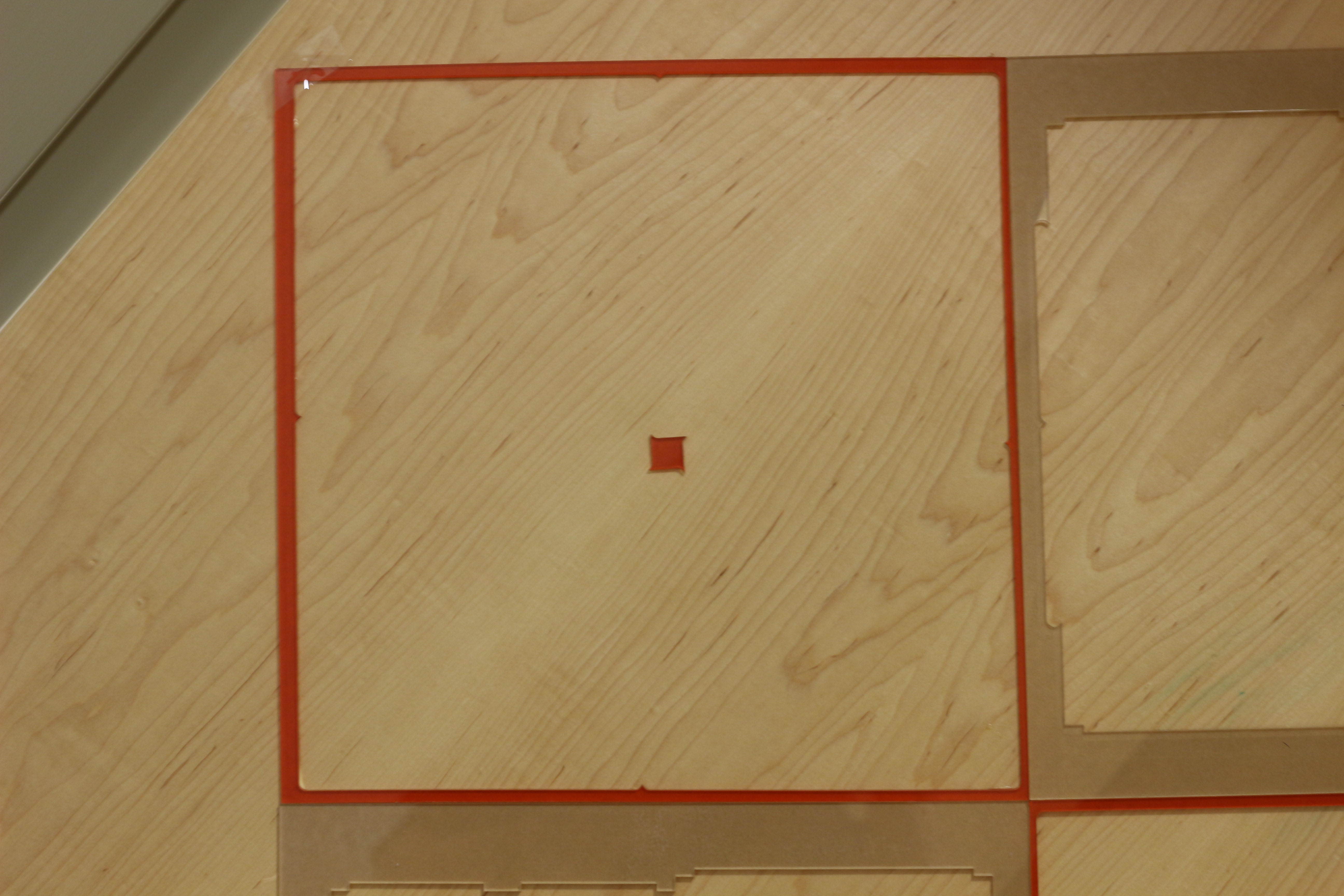
The first problem was that the parts I wanted to cut were 6×5 inches and would barely barley fit on a 12×12 sheet (as seen on the right).  I am pretty careful, and given a few thou over 12″, I was pretty sure I could cut out parts per sheet, like on the right- but the sheet was smaller by 1/8-1/4″ on each side!  So I went ahead and re-arranged the cusheet in coreldraw into a pinwheel shape (strangely, corel is much better than solidworks for this), and I ended up with excellent results, as seen below!

IMG_2122

The nice thing about packing parts like this is you get to share edges, which is basically 50% off the cut time for that edge, plus you save on material between parts and have a lower chance of melting or warping parts with nearby cuts.

IMG_2121

One of the nice things about the gel box is that most of the parts have similar-sized notches cut in them for mortise joints.  By keeping these the same throughout the box, the parts are easier to arrange, and they can share cuts!  A tip here is to make groupings of parts, and arrange them (sharing edges) into mega-parts that have edges that are easy to share with other mega-parts.  That is how i ended up with these cutouts being so clean.  You can see on the bottom two cutouts that the parts were mirrored across a horizontal line, and on the top the parts were pinwheeled again.

This might be it for the notes on making the gel system- I could write about boxing it all up, but I haven’t discovered a good way to do that except to do it while drinking a hot beverage or while watching a movie.

GelIS Production Pt 1: Lead Times

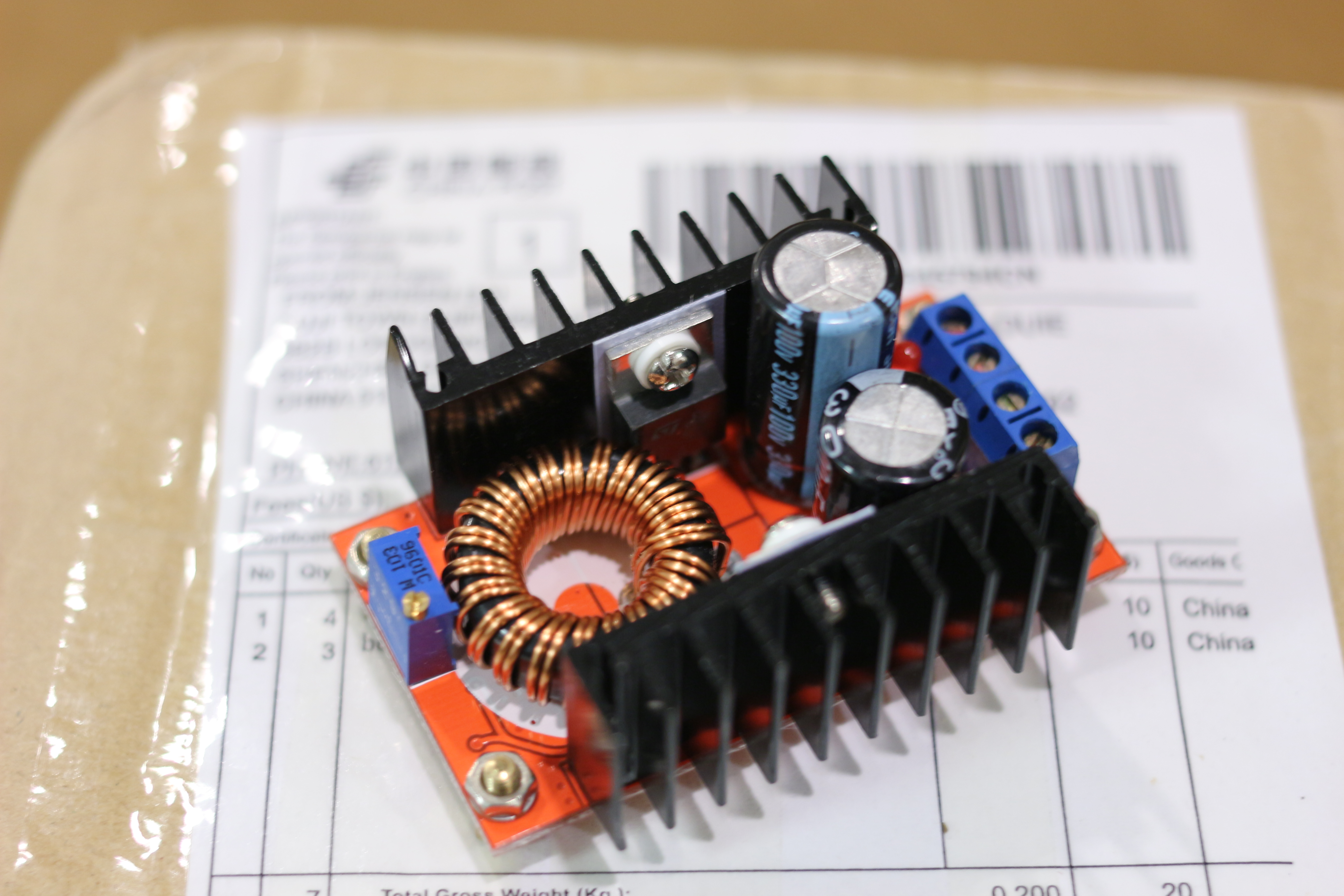
DC-DC converter, the heart of the Gel Power Supply

DC-DC converter, the heart of the Gel Power Supply

Sourcing this part is critical to being able to continue to sell GelIS.  Unfortunately there is an incredibly long lead time on these parts, as they come from China.  My strategy is to generate a few orders for the box, and then order extras far far in advance.  I hope it works!  If the rate of orders keeps up, I should be ok, but otherwise delays could happen!  I will have to think carefully about this.